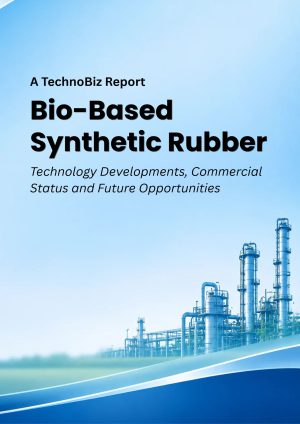
BIO-BASED SYNTHETIC RUBBER
Technology Developments, Commercial Status and Future Opportunities
A TechnoBiz Industry Report – 2027 Edition
Report Summary
Bio-Based Synthetic Rubber – Technology Developments, Commercial Status and Future Opportunities is a comprehensive industry report exploring the evolving landscape of renewable feedstocks, bio-based monomers, synthetic elastomers, manufacturing technologies and industrial commercialization.
The report presents the technology development journeys of leading manufacturers, technology developers, industrial consortia and research institutions worldwide, highlighting their scientific achievements, technological innovations, industrial developments and emerging commercial opportunities.
Covering bio-based butadiene, isoprene, ethylene, farnesene, itaconate elastomers and other emerging renewable materials, the report provides detailed insights into production technologies, rubber chemistry, manufacturing processes, compounding, material performance and industrial applications.
The publication also addresses production economics, investment feasibility, technology licensing, life cycle assessment, carbon footprint, renewable-content measurement, certification and regulatory requirements. Special emphasis is placed on global research developments and future opportunities for the Asian rubber and chemical industries.
Report Format & Specifications
- Publisher: TechnoBiz
- Edition: 2027
- Format: Digital Publication (E-Book)
- Number of Pages: 274
- Number of Parts: 16
- Number of Chapters: 74
- Technical Tables: 159
- Illustrations: 17
- Appendices: 15
- Language: English
Purpose of the Report
This report has been developed to help industry professionals understand the scientific, technological and commercial developments shaping the future of bio-based synthetic rubber. It serves as a practical reference for technology assessment, material selection, research planning, business development, manufacturing, procurement and investment decision-making.
The report adopts a constructive and evidence-based approach, recognizing industrial achievements, respecting innovation efforts and identifying future opportunities while objectively discussing technological and commercial challenges.
Key Highlights
- Global developments in bio-based synthetic rubber technologies.
- Renewable feedstocks and alternative carbon sources.
- Bio-based monomer chemistry and production pathways.
- Technology development journeys of leading industrial companies.
- Commercially marketed renewable rubber materials and emerging technologies.
- Rubber manufacturing, compounding, testing and performance.
- Industrial applications in tyre and non-tyre sectors.
- Production economics, technology licensing and investment opportunities.
- Physical bio-based content and mass-balance attribution.
- Sustainability, carbon footprint, standards and certification.
- Global scientific research and emerging elastomer technologies.
- Regional developments and business opportunities in Asia.
- Future technology development scenarios and strategic roadmaps.
Detailed Report Contents
The report is organized into 16 major parts, comprising 74 chapters and 15 appendices.
PART 1 – INDUSTRY FUNDAMENTALS
- Chapter 1 – Key Findings and Maturity Assessment
- Chapter 2 – Definitions and Classification
- Chapter 3 – Synthetic Rubber Industry Baseline
- Chapter 4 – Research Methodology and Evidence
PART 2 – RENEWABLE FEEDSTOCKS AND CARBON SOURCES
- Chapter 5 – Conventional and Emerging Biomass
- Chapter 6 – Feedstock Supply and Competition
- Chapter 7 – Alternative Carbon and Integrated Biorefineries
PART 3 – MONOMERS AND CONVERSION TECHNOLOGIES
- Chapter 8 – Bio-Based Butadiene
- Chapter 9 – Bio-Based Isoprene
- Chapter 10 – Other Renewable Monomers
- Chapter 11 – Engineering Calculations and Process Comparisons
PART 4 – SYNTHETIC RUBBER FAMILIES
- Chapter 12 – SBR and Synthetic Latex
- Chapter 13 – Polybutadiene and Synthetic Polyisoprene
- Chapter 14 – EPDM and Nitrile Elastomers
- Chapter 15 – Butyl and Specialty Rubbers
- Chapter 16 – Emerging Elastomers and Liquid Rubbers
PART 5 – MANUFACTURING AND SCALE-UP
- Chapter 17 – Industrial Production Engineering
- Chapter 18 – Scale-Up and Process Safety
- Chapter 19 – Retrofitting and Industrial Integration
PART 6 – COMPOUNDING, TESTING AND PERFORMANCE
- Chapter 20 – Molecular and Material Equivalence
- Chapter 21 – Compounding and Processing
- Chapter 22 – Testing and Validation
- Chapter 23 – Durability, End of Life and Wear
PART 7 – TECHNOLOGY SUPPLIERS AND THEIR JOURNEYS
- Chapter 24 – Michelin–IFPEN–Axens (BioButterfly)
- Chapter 25 – Kuraray
- Chapter 26 – Synthos–Lummus Technology
- Chapter 27 – Zeon Corporation
- Chapter 28 – Yokohama Rubber
- Chapter 29 – Bridgestone–PNNL
- Chapter 30 – Goodyear–Genencor and Visolis Initiatives
- Chapter 31 – Visolis
- Chapter 32 – Versalis–Genomatica (Geno)
- Chapter 33 – Amyris and Technology Successors
- Chapter 34 – ENEOS Materials
- Chapter 35 – ARLANXEO
- Chapter 36 – Global Bioenergies
- Chapter 37 – Dow
- Chapter 38 – Braskem
- Chapter 39 – OMV
- Chapter 40 – Sumitomo Rubber Industries
- Chapter 41 – RUBBIO Consortium
- Chapter 42 – Emerging Biotechnology Developers
- Chapter 43 – Emerging Asian Technology Developers
PART 8 – INDUSTRIAL PROJECTS AND COMMERCIALIZATION LESSONS
- Chapter 44 – Global Project Register
- Chapter 45 – Industrial Application Case Studies
- Chapter 46 – Cross-Supplier Lessons
PART 9 – APPLICATIONS, MARKET INTELLIGENCE AND ADOPTION
- Chapter 47 – Tyre Applications
- Chapter 48 – Non-Tyre and Latex Applications
- Chapter 49 – Grade-Level Market Intelligence
- Chapter 50 – Procurement and Customer Qualification
PART 10 – ECONOMICS, INVESTMENT AND BUSINESS MODELS
- Chapter 51 – Techno-Economic Analysis
- Chapter 52 – Investment Feasibility and Financing
- Chapter 53 – Technology Transfer and Business Models
PART 11 – SUSTAINABILITY, CARBON FOOTPRINT AND CIRCULARITY
- Chapter 54 – Life Cycle Assessment
- Chapter 55 – Use Phase and Circularity
- Chapter 56 – Renewable Content Calculations and Claims
PART 12 – STANDARDS, CERTIFICATION AND PRODUCT SAFETY
- Chapter 57 – Standards and Certification
- Chapter 58 – Traceability and Assurance
- Chapter 59 – Regulations and Product Compliance
PART 13 – REGIONAL DEVELOPMENTS AND ASIAN OPPORTUNITIES
- Chapter 60 – Europe and Americas
- Chapter 61 – Asia-Pacific Opportunities
PART 14 – NATURAL RUBBER AND INDUSTRY IMPLICATIONS
- Chapter 62 – Natural Rubber Competition and Complementarity
- Chapter 63 – Industry Transition and Supply Security
PART 15 – FUTURE OUTLOOK AND DECISION TOOLS
- Chapter 64 – Research Gaps and Competencies
- Chapter 65 – Scenarios to 2040
- Chapter 66 – Strategic Roadmap and Recommendations
PART 16 – GLOBAL RESEARCH DEVELOPMENTS AND EMERGING TECHNOLOGIES
- Chapter 67 – Global Research Landscape and Annual Intelligence
- Chapter 68 – Research Updates from Leading Research Groups: An Editorial Review
- Chapter 69 – Fraunhofer Technology Research Journeys
- Chapter 70 – China’s Research and Scale-Up Journey
- Chapter 71 – Published Researcher Perspectives and Future Dialogue
- Chapter 72 – Emerging Research Themes and Opportunities for Young Researchers
- Chapter 73 – Research-to-Commercialization and Technology Transfer
- Chapter 74 – Global Research Collaboration Directory and Priorities
Appendices and Practical Reference Materials
- Appendix A – Supplier and Licensor Directory
- Appendix B – Commercial Grade Register
- Appendix C – Facility and Project Tracker
- Appendix D – Patent Families Register
- Appendix E – Annotated Literature and Related Publications
- Appendix F – Standards Directory
- Appendix G – Supplier Enquiry, Procurement and Qualification Tools
- Appendix H – Engineering Calculations and Conversion Factors
- Appendix I – Chemical Structure Atlas
- Appendix J – Chronology of Industrial Milestones
- Appendix K – Investment Screening, Due Diligence and Risk Register
- Appendix L – Research Institutions, Funding Programmes and Contributor Guidance
- Appendix M – LCA and Environmental Evidence Register
- Appendix N – Glossary and Abbreviations
- Appendix O – Index of Companies, Technologies and Topics
The report also includes an extensive references section covering scientific publications, patents, company announcements, technical documents, standards and other relevant public information sources.
Who Should Read This Report?
- Synthetic rubber manufacturers
- Tyre manufacturers
- Rubber product manufacturers
- Rubber compounders and formulation specialists
- Polymer scientists and rubber technologists
- Chemical and renewable monomer manufacturers
- Biotechnology and biorefinery companies
- Technology developers and licensors
- Raw material suppliers
- Research scientists and academic institutions
- Sustainability and environmental professionals
- Business development and strategic planning managers
- Procurement professionals
- Investors, consultants and industry analysts
- Government agencies and policymakers
- Entrepreneurs exploring renewable material opportunities
Why This Report Is Important
As the global rubber industry explores renewable carbon sources and sustainable manufacturing pathways, understanding the scientific, technological and commercial realities of bio-based synthetic rubber is becoming increasingly important.
This publication brings together technical knowledge, industrial achievements, technology supplier intelligence, global research developments, engineering analysis and future business opportunities in a single comprehensive reference. It helps industry professionals understand technology maturity, evaluate emerging materials, identify potential collaborations and make informed technical and commercial decisions.
A valuable industry reference for professionals seeking to understand, participate in and contribute to the future development of bio-based synthetic rubber.