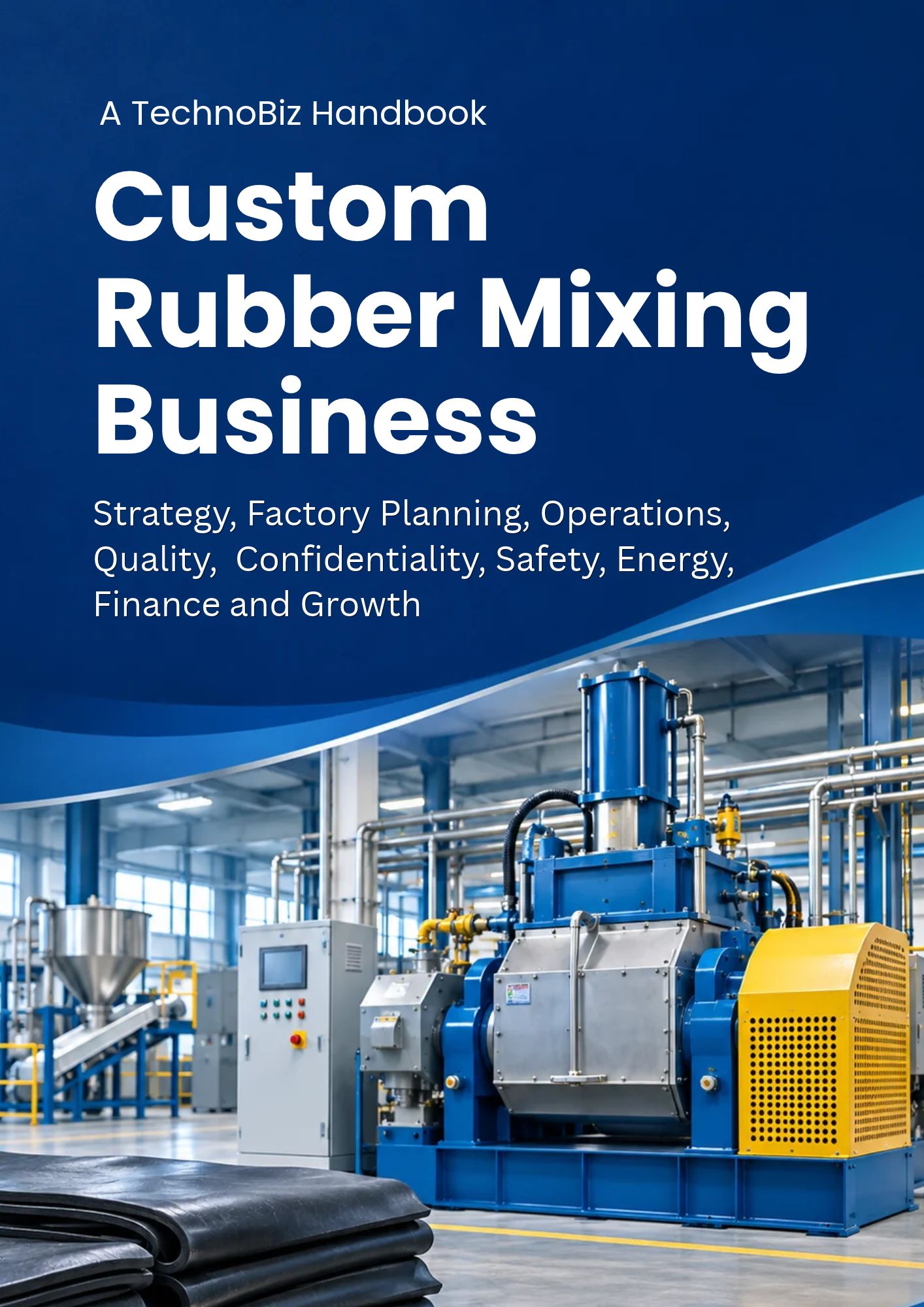
Custom Rubber Mixing Business
Strategy, Factory Planning, Operations, Quality, Confidentiality, Safety, Energy, Finance and Growth
A TechnoBiz Handbook for Owners, Managers and Industry Professionals
Book Summary
The Custom Rubber Mixing Business Handbook is a comprehensive practical reference covering the technical, commercial, financial and strategic aspects of establishing, managing and growing a profitable rubber compounding enterprise.
Unlike conventional rubber mixing technology books, this handbook addresses the entire business ecosystem, including market development, factory layout and design, machinery selection, raw material procurement, production management, quality control, formulation confidentiality, occupational safety, energy management, costing, pricing, customer relationships, digitalization and sustainable growth.
The handbook includes practical calculation models, management frameworks, technical illustrations, hypothetical business scenarios, checklists and implementation guidelines. It also presents eleven independent and inspiring company journeys from the global rubber compounding industry, recognizing entrepreneurship, technological achievements, innovation and industry contributions.
Book Format
- Publisher: TechnoBiz
- Edition: First Edition, 2026
- Format: Digital Handbook (PDF)
- Pages: 279
- Contents: 25 Parts, 84 Chapters and 10 Appendices
- Language: English
Book Purpose
To help entrepreneurs, business owners and industry professionals establish, manage and improve custom rubber mixing enterprises that are technically competent, operationally efficient, commercially profitable, safe and trusted by customers.
The handbook bridges the gap between rubber compounding technology and business management, providing practical guidance for informed investment, operational excellence, customer development and long-term business growth.
Book Contents
Part 1 – Industry and Market Context
- Chapter 1. The Custom Rubber Mixing Industry
- Chapter 2. Market Intelligence and Segmentation
Part 2 – Business Models and Strategic Positioning
- Chapter 3. Business Models and Ownership
- Chapter 4. Customer Make-or-Buy Decisions
- Chapter 5. Strategy and Service Portfolio
Part 3 – Feasibility and Investment Planning
- Chapter 6. Market Validation and Feasibility
- Chapter 7. Investment and Financing
Part 4 – Factory Planning, Layout and Engineering
- Chapter 8. Capacity and Master Planning
- Chapter 9. Factory Layout and Material Flow
- Chapter 10. Building, Zoning and Infrastructure
- Chapter 11. Design Alternatives and Project Execution
Part 5 – Machinery, Equipment and Technology Selection
- Chapter 12. Mixing Equipment and Line Configuration
- Chapter 13. Feeding, Handling and Automation Equipment
- Chapter 14. Supplier Evaluation and Asset Acquisition
Part 6 – Procurement and Supply Chain
- Chapter 15. Strategic Sourcing and Supplier Management
- Chapter 16. Supply Chain Resilience and Purchasing Controls
Part 7 – Inventory and Material Accountability
- Chapter 17. Inventory Ownership and Control
- Chapter 18. Mass Balance and Reconciliation
Part 8 – Mixing Technology and Technical Know-How
- Chapter 19. Mixing Fundamentals and Process Design
- Chapter 20. Formulation Transfer and Scale-Up
- Chapter 21. Technical Services and Troubleshooting
Part 9 – Production Planning and Operational Excellence
- Chapter 22. Multi-Customer Planning and Scheduling
- Chapter 23. Production Control and Productivity
- Chapter 24. Changeovers and Process Governance
Part 10 – Quality Assurance and Laboratory Management
- Chapter 25. Quality System and Customer Specifications
- Chapter 26. Incoming Materials and Weighing Verification
- Chapter 27. In-Process Control and Compound Testing
- Chapter 28. Laboratory Design and Measurement Reliability
- Chapter 29. Statistical Quality and Batch Consistency
- Chapter 30. Qualification, Change Control and Batch Release
- Chapter 31. Nonconformity, Complaints and Quality Economics
Part 11 – Confidentiality, Intellectual Property and Cybersecurity
- Chapter 32. Ownership and Contractual Protection
- Chapter 33. Secure Recipe Lifecycle and Shop-Floor Controls
- Chapter 34. People, Visitors and Competing Customers
- Chapter 35. Cybersecurity and Breach Response
Part 12 – Safety, Occupational Health and Material Handling
- Chapter 36. Safety Leadership and Risk Governance
- Chapter 37. Chemical, Warehouse and Material Handling Safety
- Chapter 38. Machinery and Maintenance Safety
- Chapter 39. Thermal, Fire and Occupational Exposure Risks
- Chapter 40. New Formulation Safety Approval and Emergency Response
Part 13 – Energy and Utility Management
- Chapter 41. Energy Mapping and Measurement
- Chapter 42. Mixer and Utility Optimisation
- Chapter 43. Energy Economics and Procurement
- Chapter 44. Energy Resilience and Carbon Reporting
Part 14 – Maintenance, Reliability and Asset Management
- Chapter 45. Reliability and Maintenance Systems
- Chapter 46. Asset Life Cycle and Spares
Part 15 – People and Organisational Development
- Chapter 47. Organisation and Workforce Planning
- Chapter 48. Leadership, Retention and Knowledge Continuity
Part 16 – Business Economics, Costing and Finance
- Chapter 49. True Cost of Mixing
- Chapter 50. Pricing and Order Profitability
- Chapter 51. Break-Even and Investment Economics
- Chapter 52. Cash Flow and Working Capital
- Chapter 53. Management Accounting and Hidden Losses
Part 17 – Marketing, Branding and Business Development
- Chapter 54. Market Segmentation and Customer Buying Behaviour
- Chapter 55. Value Proposition and Positioning
- Chapter 56. Marketing Strategy and Lead Generation
- Chapter 57. Brand and Digital Marketing
- Chapter 58. Exhibitions and Knowledge-Based Marketing
- Chapter 59. Marketing Measurement and Growth
Part 18 – Technical Sales and Customer Relationships
- Chapter 60. Enquiry-to-Order Conversion
- Chapter 61. Customer Onboarding and Account Development
- Chapter 62. Outsourcing Conversion and Commercial Objections
Part 19 – Contracts, Compliance and Insurance
- Chapter 63. Commercial and Quality Agreements
- Chapter 64. Regulatory Compliance and Product Stewardship
- Chapter 65. Insurance and Risk Transfer
Part 20 – Packaging, Logistics and Delivery
- Chapter 66. Finished Compound Handling and Storage
- Chapter 67. Distribution and Delivery Performance
Part 21 – Digitalisation, Automation and AI
- Chapter 68. Integrated Digital Architecture
- Chapter 69. Automation and Responsible AI
Part 22 – Sustainability, Waste and Circularity
- Chapter 70. Environmental and Circular Compounding
Part 23 – Ethics, Risk Management and Continuity
- Chapter 71. Governance and Business Ethics
- Chapter 72. Business Continuity and Crisis Management
Part 24 – Strategic Growth and Transformation
- Chapter 73. Growth, International Expansion and Ownership Transition
Part 25 – Global Custom Rubber Mixing Business Journeys
- Chapter 74. HEXPOL – Building a Global Compounding Enterprise
- Chapter 75. Gummiwerk KRAIBURG – Long-Term Entrepreneurship and Technical Development
- Chapter 76. AirBoss Rubber Solutions – Custom Compounds for Diverse Applications
- Chapter 77. American Phoenix – Creating New Opportunities from Industrial Assets
- Chapter 78. Polymer-Technik Elbe – Building an International Manufacturing Presence
- Chapter 79. SPC Rubber Group – Specialisation in Technical and Coloured Compounds
- Chapter 80. Clwyd Compounders – Scientific Knowledge as a Business Foundation
- Chapter 81. Elastomix (Thailand) – Establishing Regional Compounding Capability
- Chapter 82. Saiko Rubber – Building a Southeast Asian Compounding Enterprise
- Chapter 83. SVAN Elastomer Solutions – Designing a Focused Mixing Enterprise
- Chapter 84. Titron Rubber Industries – Developing Tailored Compound Services
Appendices
- Appendix A – Signature Practical Management Tools
- Appendix B – Formula Reference
- Appendix C – Standards Register
- Appendix D – Glossary and Abbreviations
- Appendix E – Practical Management Forms
- Appendix F – Supplier and Technology Research Guide
- Appendix G – Additional Hypothetical Teaching Cases
- Appendix H – Companion Calculation Models and Dashboard Specifications
- Appendix I – References and Verification Register
- Appendix J – Subject Navigation Guide
Special Features of the Handbook
- Practical guidance for establishing a new custom rubber mixing business.
- Business development strategies for existing rubber compounding enterprises.
- Conceptual factory layouts and engineering illustrations.
- Separate financial approaches for toll mixing and full-service compounding.
- Customer-wise and compound-wise profitability analysis.
- Formulation confidentiality and intellectual property protection.
- Compound Manufacturing Passport.
- Customer Order Acceptance Framework.
- Customer Complexity and Cost-to-Serve Assessment.
- Custom Rubber Mixing Business Maturity Assessment.
- Practical financial and engineering calculations.
- Management checklists, forms and performance indicators.
- Eleven independent and inspiring company journeys, presented without comparisons or rankings.
Who Should Read This Handbook?
- Custom rubber mixing business owners and CEOs
- Entrepreneurs and prospective investors
- Rubber compounding professionals
- Factory and production managers
- Rubber technologists and compound developers
- Quality control and laboratory professionals
- Safety, energy and maintenance professionals
- Sales, marketing and business development professionals
- Rubber product manufacturers considering outsourcing
- Machinery, equipment and raw material suppliers
- Industry consultants, researchers and educators
Why Read This Handbook?
Making a good rubber compound is a technical capability. Making it consistently, safely, confidentially and profitably is a business capability.
This handbook brings these capabilities together, serving as a valuable reference for building a reliable, competitive and sustainably profitable custom rubber mixing enterprise.
Available at TechnoBiz Store: https://store.technobiz.org