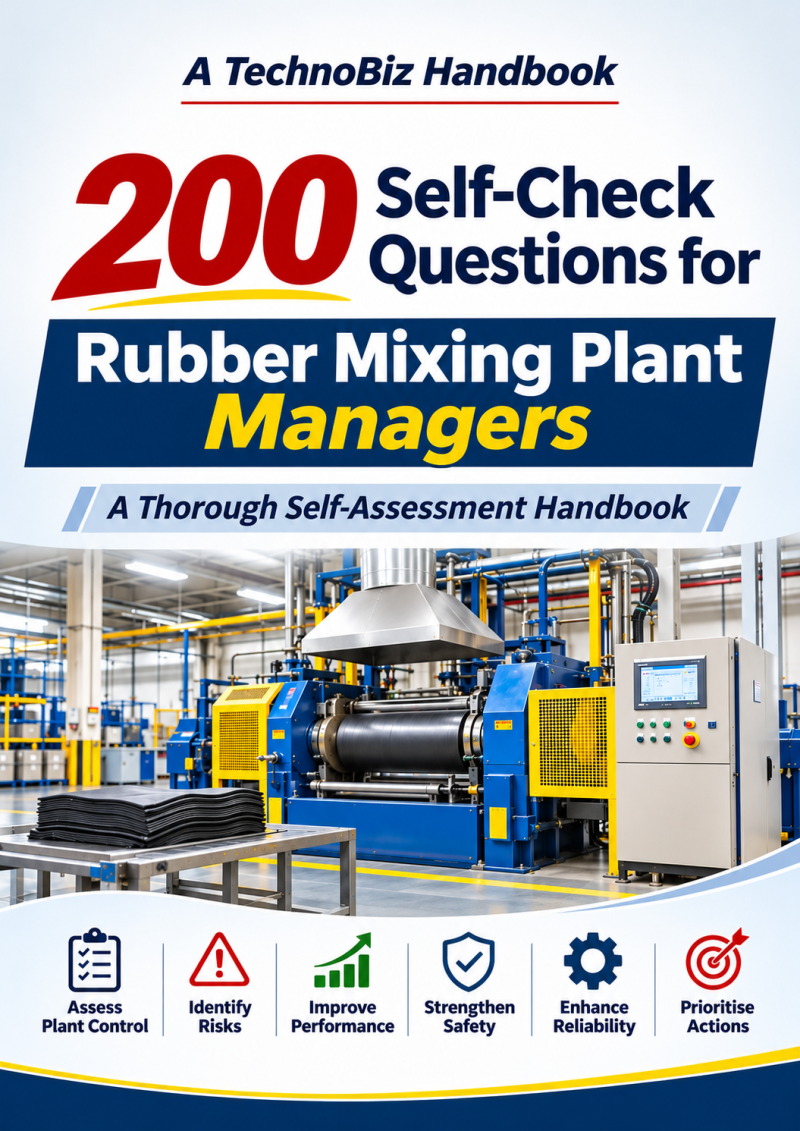
200 Self-Check Questions for Rubber Mixing Plant Managers
A Thorough Technical and Operational Self-Assessment Handbook
A TechnoBiz Handbook
Format: PDF
Length: 92 pages
Coverage: 200 Self-Check Questions | 20 Technical and Operational Sections
Companion Reference: Self-Auditing of a Rubber Mixing Plant — A TechnoBiz Handbook
About the Book
200 Self-Check Questions for Rubber Mixing Plant Managers is a practical technical thinking handbook designed for people responsible for rubber mixing operations.
Rubber mixing is one of the most technically sensitive stages of rubber manufacturing. Raw-material variability, weighing accuracy, mixer condition, operating parameters, temperature, energy input, ingredient sequence, cooling, laboratory testing, maintenance, utilities and operator decisions can all influence compound quality and production performance. A plant may appear to be operating normally while small deviations are gradually creating variability, hidden losses, quality problems or reliability risks.
This handbook helps managers look beyond routine production output and ask deeper questions about what is actually happening inside the mixing operation.
Rather than presenting another conventional technical textbook, the book uses 200 carefully developed technical and operational questions to encourage the reader to:
- think critically about the process;
- observe actual shop-floor conditions;
- verify assumptions with evidence;
- examine process and equipment trends;
- identify hidden risks and abnormal practices;
- investigate recurring problems;
- recognise gradual deterioration;
- strengthen technical discussions with the plant team; and
- determine what should be investigated or improved next.
The central philosophy is simple:
This book does not provide 200 answers. It provides 200 technically meaningful questions that encourage a Rubber Mixing Plant Manager to think, observe, verify, investigate and improve.
Why There Are No Answers
This handbook intentionally does not provide an answer key, Yes/No checklist, numerical score, grading system or pass/fail rating.
Every rubber mixing plant is different. Equipment design, rotor configuration, automation, raw materials, compound families, laboratory systems, customer requirements and operating conditions vary considerably from plant to plant. A standard printed answer could therefore oversimplify an issue that requires plant-specific technical judgement.
Instead, the manager is encouraged to ask:
What happens in our plant? How do I know? What evidence supports this? What happens when the normal control fails? What should we investigate next?
A good response should be specific, evidence-based, honest about uncertainty and useful for making a decision.
What Makes This Handbook Different
The questions are not designed as simple compliance checks.
Instead of asking:
“Are weighing scales calibrated?”
the handbook asks questions such as:
“What would tell us that a weighing system had begun drifting between scheduled calibrations?”
Instead of asking:
“Is cooling adequate?”
the reader is challenged to consider:
“During the hottest production period, where does cooling capacity first begin limiting the mixing process?”
The objective is to move the reader from checking whether a system exists to understanding whether the system is actually controlling the technical risk.
200 Questions Across 20 Technical Areas
The 200 questions are arranged into 20 sections of 10 questions each, following the rubber mixing operation from raw materials through processing, testing, traceability, maintenance, safety, energy and troubleshooting. The handbook deliberately keeps its focus on technical and operational subjects rather than general leadership or corporate management topics.
Materials and Preparation
1. Raw-Material Specifications & Incoming Quality — Q1–Q10
Explores raw-material variability, incoming inspection, supplier changes, critical material characteristics, certificates of analysis and the relationship between material properties and mixing behaviour.
2. Material Receiving, Storage & Inventory Condition — Q11–Q20
Examines receiving errors, silo and tanker controls, material identification, storage conditions, FIFO/FEFO, moisture and temperature sensitivity, partial materials, inventory discrepancies and contamination.
3. Rubber Preparation — Q21–Q30
Covers bale identification, cutting, preparation consistency, batch weight, contamination, polymer handling, conditioning and the influence of rubber preparation on mixer behaviour.
4. Chemical Weighing & Dispensing — Q31–Q40
Focuses on weighing accuracy, ingredient identity, small-dose chemicals, scale condition, barcode systems, batch kits, manual overrides and error-proofing.
5. Fillers, Silica, Oils & Liquid Ingredients — Q41–Q50
Examines carbon black and silica feeding, filler moisture, silane systems, oil and liquid dosing, blocked lines, metering accuracy, ingredient sequence and automated-system reliability.
The Mixing Process
6. Cross-Contamination, Cleaning & Changeover — Q51–Q60
Challenges the reader to examine contamination risks, cleaning effectiveness, production sequencing, cure-system changes, colour changes and cleaning validation.
7. Internal Mixer Mechanical Condition — Q61–Q70
Looks at rotors, chamber wear, clearances, ram condition, drop door, seals, bearings, cooling passages, leakage and sensors.
8. Internal Mixer Operating Parameters — Q71–Q80
Covers fill factor, batch weight, rotor speed, ram pressure, mixing time, temperature, specific energy, torque, power and validated operating windows.
9. Mixing Cycle & Ingredient-Addition Sequence — Q81–Q90
Examines masterbatch and final-mix cycles, addition timing, power and temperature profiles, dump criteria, silica/silane processing, scorch-sensitive compounds and cycle variability.
10. Open Mill, Batch-Off & Compound Cooling — Q91–Q100
Addresses mill condition, roll temperature, nip settings, sheet thickness, anti-tack systems, cooling performance, residual heat, stacking and downstream handling.
Process Control and Quality
11. Intermediate Masterbatch Storage & Inter-Stage Control — Q101–Q110
Explores masterbatch cooling, resting, maturation, storage time, identification, FIFO, inter-stage traceability and final-mix release.
12. Startup, Shutdown, Alarms, Interlocks & Bypasses — Q111–Q120
Examines abnormal operating conditions, power interruption, alarm management, safety and process interlocks, bypass controls, sensor failures and restart practices.
13. Process Validation, Capability & SPC — Q121–Q130
Covers process validation, critical parameters, Cp/Cpk, Pp/Ppk, control charts, process drift, reaction plans, special causes and process stability.
14. Sampling, Testing, Dispersion & Laboratory Reliability — Q131–Q140
Looks at sampling integrity, rheometer testing, Mooney viscosity, dispersion, measurement-system reliability, laboratory variation, out-of-specification results and retention samples.
15. Non-Conforming Compound, Rework & Finished Compound — Q141–Q150
Examines segregation, disposition, rework, reprocessing, scrap, downgrade, compound compatibility, storage, maturation and finished-compound control.
Reliability, Safety and Performance
16. Material Reconciliation, Genealogy & Traceability — Q151–Q160
Challenges the plant’s ability to perform forward and reverse tracing, maintain batch genealogy, account for rework and understand unexplained material losses.
17. Maintenance, Reliability & Calibration — Q161–Q170
Covers preventive and predictive maintenance, repeat failures, critical equipment, critical spares, condition monitoring, calibration and post-maintenance verification.
18. Utilities, Cooling & Support Systems — Q171–Q180
Examines cooling water, chilled water, pumps, heat exchangers, compressed air, hydraulics, electrical supply, extraction systems, seasonal performance and utility capacity.
19. Mixing-Plant Safety & Operational Risk — Q181–Q190
Addresses mixer and mill safety, stored energy, guarding, emergency stops, combustible dust, chemical exposure, fire risk, non-routine tasks and emergency restart.
20. Energy, Productivity, Process Losses & Troubleshooting — Q191–Q200
Explores specific energy, cycle time, utilisation, OEE, yield, scrap, rework, hidden losses, technical troubleshooting, root-cause investigation and continuous improvement.
Different Types of Self-Check Questions
The handbook deliberately uses several types of questions rather than repeating one checklist format.
These include:
- Diagnostic — understand what is happening technically and why.
- Show Me — ask for actual records, data or physical evidence.
- Go and Look — move from the office to the shop floor and observe the real condition.
- Compare — understand why mixers, shifts, compounds, lots or operating periods behave differently.
- Trend — identify gradual changes before they become failures.
- What If? — challenge preparedness for abnormal conditions.
- Scenario — investigate realistic technical situations.
- Plant Condition — honestly assess the present level of operating practice.
- Misconception Check — challenge technical assumptions that may not always be true.
Open-ended technical formats form the majority of the handbook, helping the reader think and investigate rather than simply tick boxes.
How to Use the Handbook
The handbook can be used section by section rather than being completed in one sitting.
A practical learning process is:
QUESTION → THINK → OBSERVE → VERIFY → REFER → INVESTIGATE → IMPROVE
Managers are encouraged to select questions during plant walks, technical meetings, maintenance reviews, quality discussions, problem-solving sessions and improvement workshops. One practical approach suggested in the handbook is to work through one section each week, covering all 20 sections over approximately five months, then repeat the review periodically to see what has changed.
For each question, the reader is encouraged to think first, visit the relevant area where useful, speak with the people closest to the process, examine records and trends, compare standards against actual practice, identify uncertainty and decide whether further investigation is necessary.
Companion to Self-Auditing of a Rubber Mixing Plant
This handbook is deliberately designed as a companion to Self-Auditing of a Rubber Mixing Plant — A TechnoBiz Handbook.
The two books have different but complementary purposes.
200 Self-Check Questions for Rubber Mixing Plant Managers helps the reader identify the right questions and areas requiring deeper attention.
Self-Auditing of a Rubber Mixing Plant provides the more detailed audit methodology, technical explanations, field observations, checklists, red flags and investigation tools needed for deeper examination.
Every major question section contains a Technical Reference directing readers to relevant chapters of the Self-Auditing handbook.
Who Should Read This Book?
The primary reader is the Rubber Mixing Plant Manager, but the handbook is equally useful for:
- Factory Managers responsible for rubber mixing operations;
- Production Managers;
- Mixing Managers;
- Process Engineers;
- Compound Engineers;
- Technical Managers;
- Quality Managers and Quality Engineers;
- Maintenance Managers;
- Reliability Engineers;
- EHS and Safety Managers;
- Senior Mixing Supervisors;
- engineers and supervisors preparing for plant-management responsibilities.
The book does not expect every manager to be an expert in laboratory testing, maintenance, controls, safety engineering or every compound technology. Instead, it helps managers understand which technical questions matter, who should be able to provide the evidence and when deeper investigation is necessary.
Why Should Rubber Mixing Professionals Read This Book?
This handbook can help a plant manager:
- identify technical risks before they become customer problems;
- recognise process variation that has gradually become accepted as normal;
- challenge long-standing assumptions and informal practices;
- detect equipment or utility deterioration earlier;
- understand whether process controls are genuinely effective;
- improve technical discussions between production, quality, maintenance, laboratory and EHS teams;
- find opportunities to reduce scrap, rework, energy loss and unnecessary cycle time;
- strengthen traceability and material reconciliation;
- identify weaknesses in abnormal-condition preparedness;
- improve reliability and process consistency;
- focus investigation on evidence rather than opinion;
- develop stronger technical awareness across the plant; and
- decide where improvement effort should be prioritised.
The final purpose is not simply to complete 200 questions. It is to create a habit of technical curiosity, evidence-based thinking and continuous improvement.
Practical Tools Included
In addition to the 200 questions, the handbook includes:
- a Technical Reference Map linking the 20 sections to the companion Self-Auditing handbook;
- an index grouping the questions by question type;
- guidance on moving from questions to structured investigation;
- a practical method for prioritising issues according to consequence, uncertainty and detectability; and
- a Plant Review Record for capturing what was observed, what remains uncertain and what should be investigated next.
Purchasers may reproduce individual questions and the blank Plant Review Record for internal use within their own organisation, including plant walks, technical reviews and training sessions.
A Practical Technical Thinking Tool
200 Self-Check Questions for Rubber Mixing Plant Managers is designed to be used, discussed and revisited—not simply read once and placed on a shelf.
It provides a structured way for managers and technical teams to continuously ask:
What is happening technically?
How do we know?
What evidence supports it?
What is changing?
What happens if the control fails?
What have we accepted as normal?
What should we investigate next?
For rubber companies seeking to strengthen process control, compound consistency, reliability, safety, traceability, energy performance, productivity and technical decision-making, this handbook provides a practical framework for looking at the mixing plant with fresh and more critical eyes.