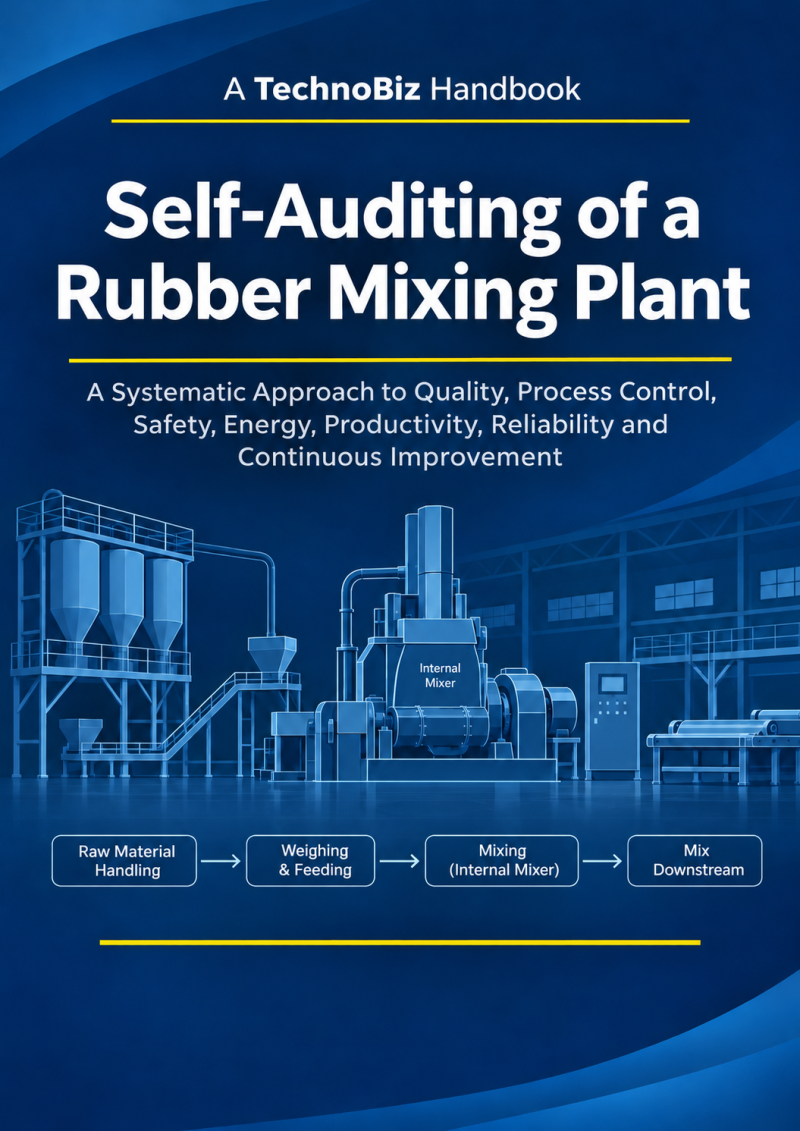
Self-Auditing of a Rubber Mixing Plant
A Systematic Approach to Quality, Process Control, Safety, Energy, Productivity, Reliability and Continuous Improvement
Book Format: PDF | Length: 681 Pages | Edition: First Edition, 2026 | A TechnoBiz Handbook
Self-Auditing of a Rubber Mixing Plant is a comprehensive and highly practical TechnoBiz handbook designed to help rubber mixing plants systematically evaluate their own operations, identify hidden weaknesses and convert audit findings into measurable improvements.
Rubber mixing is one of the most critical stages in rubber manufacturing. Raw-material variability, weighing accuracy, operator decisions, equipment condition, process settings, temperature, energy input and quality controls all come together in a single batch. A small deviation at the mixing stage can later appear as processing problems, rejected products, excessive scrap, customer complaints, higher energy consumption or production losses. This handbook provides a structured method for identifying these weaknesses before they become expensive failures or external audit findings.
The book is designed to be used on the plant floor, not simply read as a technical reference. Practical chapters follow a consistent audit-oriented structure incorporating observation points, common deficiencies, red flags, audit questions, mini case studies and key takeaways. The supporting appendices provide field-ready checklists, worksheets, scorecards, investigation tools and assessment formats that plants can adapt to their own equipment, products and customer requirements.
What Does This Book Cover?
The handbook contains 20 major parts, 91 chapters and 76 practical appendices, creating a complete self-audit and plant-improvement system for rubber mixing operations. It covers the entire operation—from management controls and raw-material receipt to mixing, quality, maintenance, safety, energy, productivity, digital systems, traceability and continuous improvement.
Major subjects covered include:
- Self-Auditing Fundamentals: audit methodology, systematic audit frameworks, auditor competency, risk-based auditing, audit scoring, plant health assessment and writing effective audit findings.
- Management and Process Governance: management responsibility, customer-specific requirements, recipe and specification control, SOPs, document control, management of change, PFMEA/process risk analysis and daily 4M change-point management.
- Raw Materials and Supplier Control: supplier qualification, incoming inspection, tanker and silo unloading, warehouse control, opened bags, partial materials and returned-material management.
- Material Preparation and Weighing: rubber preparation, chemical weighing and dispensing, human-error prevention and poka-yoke, carbon black and silica handling, oil systems and prevention of cross-contamination.
- Mixing Equipment and Process Control: internal mixer condition, operating parameters, mixing cycles, open mills, batch-off systems, intermediate masterbatch storage, startup and shutdown, alarms, interlocks and bypass management.
- Quality and Process Capability: process validation, SPC, sampling systems, compound testing, filler dispersion, measurement-system reliability, batch release and retention samples.
- Non-Conforming Compound and Rework: segregation, investigation, disposition, reprocessing, rework control, compound maturation, storage and dispatch.
- Traceability and Genealogy: material reconciliation, mass balance, batch genealogy and forward/reverse traceability.
- Maintenance and Reliability: preventive and predictive maintenance, critical equipment, spare parts, calibration, cooling systems and utilities.
- People and Shop-Floor Discipline: plant layout, 5S, operator competency, training, shift handover, supervisory discipline and layered process auditing.
- Digitalisation and Feedback: mixing-data management, data integrity, cybersecurity, downstream internal-customer feedback and customer complaint investigation.
- Safety and Occupational Health: machine safety, chemicals, dust exposure, combustible-dust/fire/explosion risk, ergonomics, emergency preparedness and safe restart.
- Energy, Environment and Sustainability: environmental management, comprehensive mixing-plant energy auditing, resource efficiency, sustainability, circularity and regulatory/product compliance. Energy is treated not only as a cost issue but also as an indicator of equipment condition, process stability and mixing quality.
- Productivity and Cost: utilisation, OEE, material losses, yield, scrap, mixing cost, KPI dashboards and business continuity.
- Troubleshooting and Continuous Improvement: common mixing problems, root-cause analysis, corrective action and continuous improvement through systematic self-auditing.
- Practical Audit Exercises: One-Batch Audit, forward/reverse traceability challenges and controlled system challenge tests.
- Complete Audit Execution: pre-audit preparation, plant walk-through, reporting, management review and assessment of whether the audit system itself is producing real improvements.
- Practical Self-Audit Toolkit: daily 20-question self-check, monthly 100-question focused audit, annual comprehensive audit, 28 critical/high-priority red-flag questions, 100 questions every mixing-plant manager should ask, and the Rubber Mixing Plant Health Score and Maturity Assessment.
- Practical Case Studies: twenty-two realistic mixing-plant scenarios illustrating how audit evidence, root-cause thinking and corrective action can be applied to actual operating problems.
A Three-Level Self-Auditing System
A major feature of the handbook is its practical three-level self-audit architecture.
The first level is a Daily 20-Question Self-Check for operators and supervisors, focusing on high-priority controls that should never be left unchecked.
The second level is a Monthly 100-Question Focused Audit, allowing departments to examine process discipline, materials, weighing, quality, maintenance, safety, energy, traceability and other important operating areas.
The third level is an Annual Comprehensive Self-Audit, supported by an extensive bank of more than 660 supplied questions and checkpoints across the handbook’s audit tools, checklists and worksheets.
This allows both small single-mixer operations and large multi-line mixing plants to apply the system at an appropriate level. Smaller plants can begin with daily and monthly assessments, while larger plants can use the full architecture with functional-area scoring, dashboards and management reviews.
Rubber Mixing Plant Health Score and Maturity Model
The handbook goes beyond a simple checklist approach.
Audit findings can be converted into a risk-weighted Rubber Mixing Plant Health Score covering fourteen functional areas, including management, quality, materials, weighing, mixing, laboratory, maintenance, traceability, safety, energy, sustainability, productivity/cost, people and digital systems.
The plant can then be assessed using a five-level maturity model:
Reactive → Controlled → Systematic → Predictive → Mixing Excellence
This helps management understand not only the current condition of the plant, but also what needs to change to reach the next level of operational maturity.
Who Should Read This Book?
This handbook is intended for professionals with direct or oversight responsibility for rubber and elastomer mixing operations.
Plant Managers and General Managers should read it to obtain a practical, plant-wide understanding of where operational risks exist instead of relying entirely on departmental reports. The management questions and plant-health tools help senior managers test whether key controls are genuinely working.
Quality Managers and Quality Engineers will find extensive practical guidance covering recipe control, laboratory reliability, SPC, non-conforming compounds, batch release, traceability, complaints, corrective action and audit methodology.
Production Managers and Process Engineers can use the book to connect mixer condition, operating parameters, mixing energy, temperature, batch variation and downstream processing behaviour into a systematic troubleshooting and control framework.
Maintenance and Reliability Engineers will benefit from the book’s emphasis on preventive maintenance, equipment condition, utilities, cooling performance, critical spares, calibration, energy trends and repeat-failure prevention.
Internal Auditors and Layered-Process Auditors can use the audit methodology, observation guides, questions, evidence requirements, scoring system and ready-to-use appendices directly during plant-floor audits.
EHS and Occupational Health Professionals will find integrated coverage of machine safety, chemical and dust exposure, fire and explosion hazards, ergonomics, emergency preparedness and operational controls.
Energy, Sustainability and Environmental Managers can use the dedicated energy audit and sustainability sections to connect energy use with process efficiency, equipment health, quality performance, environmental management and circularity.
Training Managers, Young Engineers and New Employees can also use the handbook as a structured learning and onboarding resource. Its consistent chapter format, practical case studies and management self-assessment questions make it suitable both for newcomers and experienced professionals who want to test their own knowledge.
Why Should Rubber Mixing Professionals Read This Book?
Many mixing plants already have procedures, checklists, quality systems and audits. The real question is whether those systems are actually working every day.
This book helps readers look beyond paperwork and ask practical questions:
Is the correct material actually being used? Is the current recipe revision protected? Are weighing mistakes prevented or merely detected later? Is mixer wear affecting dispersion? Are alarms being bypassed? Is a rise in energy consumption indicating a hidden equipment problem? Can every compound batch be traced back to its raw-material lots? Are repeated customer complaints feeding back into mixing controls? Are audit findings genuinely closed or only marked “closed” in a spreadsheet?
The handbook therefore treats self-auditing as the plant’s early-warning system. A good self-audit programme helps discover weaknesses internally—before a rejected batch, customer complaint, accident, breakdown, regulatory problem or external audit exposes them.
For organisations seeking better quality, consistency, safety, energy efficiency, productivity, traceability, reliability and continuous improvement, this handbook provides a systematic and practical framework for turning everyday plant observations into meaningful operational improvement.
Self-Auditing of a Rubber Mixing Plant is not simply a book about auditing. It is a practical operating-health system for understanding how well a rubber mixing plant is really being managed—and where it should improve next.