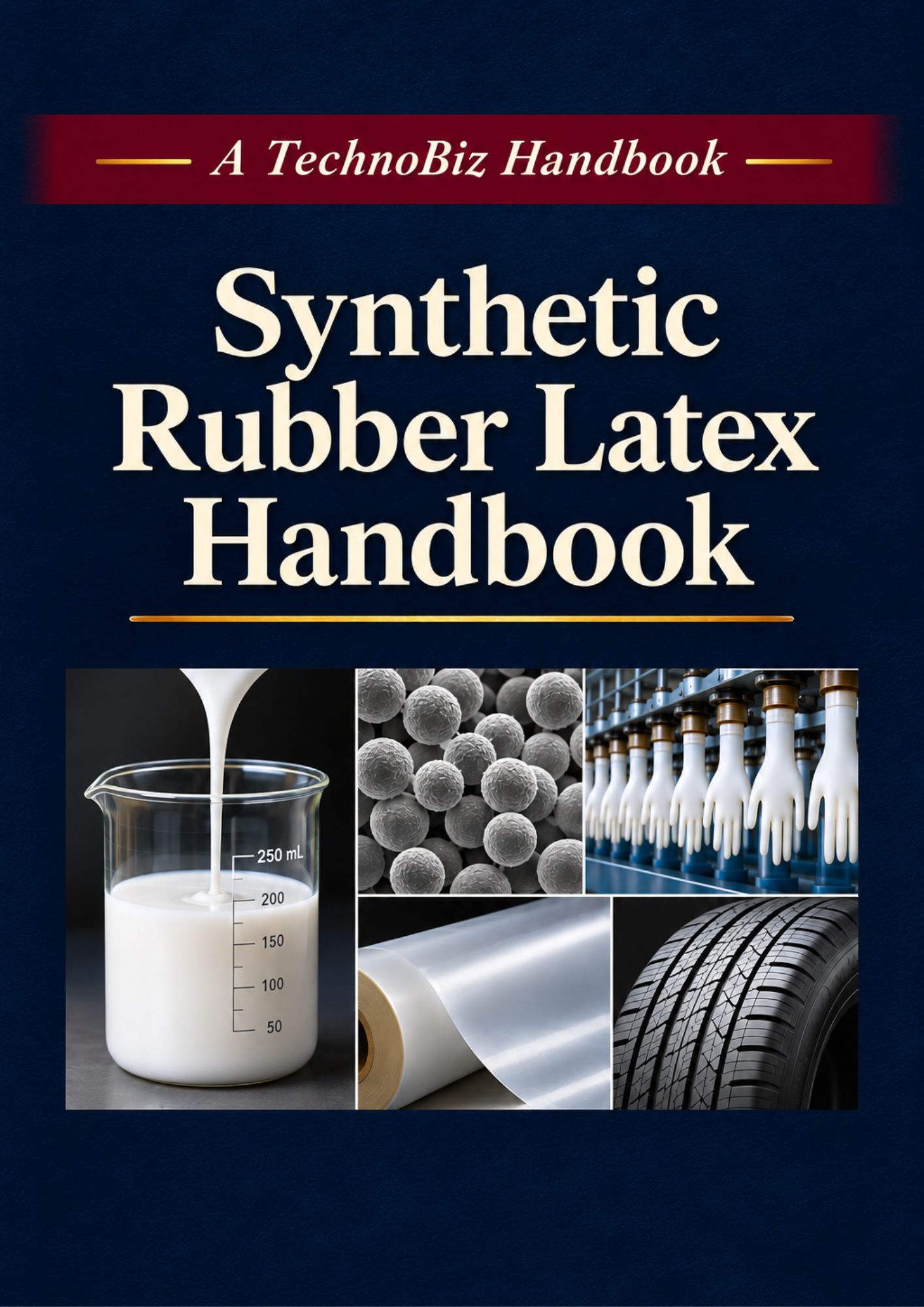
Synthetic Rubber Latex Handbook
A TechnoBiz Handbook | First Edition, 2026
Book Summary
Synthetic Rubber Latex Handbook is a comprehensive technical and practical reference covering the chemistry, manufacturing, compounding, processing, applications, testing, troubleshooting, sustainability and economics of synthetic rubber latex.
The handbook provides a systematic understanding of major synthetic rubber latex types, including SBR, XSBR, NBR, XNBR, polychloroprene (CR), synthetic polyisoprene (IR) and vinylpyridine latex.
It connects fundamental polymer and colloidal science with real industrial applications such as medical and industrial gloves, paper coatings, carpet backing, textiles, adhesives, tyre cord bonding, construction materials, foams and emerging battery technologies.
With technical illustrations, comparison tables, practical calculations, troubleshooting guides and industrial case studies, this handbook helps professionals understand material behaviour, improve manufacturing consistency, solve production problems and make informed technical and commercial decisions.
Book Purpose
The primary purpose of this handbook is to bridge the gap between scientific knowledge and industrial practice in synthetic rubber latex technology.
It aims to help readers:
- Understand synthetic rubber latex chemistry, properties and manufacturing principles.
- Select suitable latex grades for different industrial applications.
- Improve compounding, processing and product performance.
- Identify and troubleshoot common manufacturing and quality problems.
- Apply appropriate testing, quality control and supplier qualification practices.
- Improve productivity, reduce material waste and control manufacturing costs.
- Understand safety, regulatory compliance and sustainability considerations.
- Evaluate emerging technologies and opportunities for industrial applications.
The handbook is designed to serve as both a learning resource and a practical reference for everyday industrial decisions.
Book Format & Pages
- Title: Synthetic Rubber Latex Handbook
- Publisher: TechnoBiz
- Edition: First Edition, 2026
- Format: Digital Handbook (PDF)
- Total Pages: 409 PDF pages, including cover
- Structure: 14 Parts, 75 Chapters and 6 Appendices
- Features: Technical illustrations, tables, calculation examples, industrial case studies, troubleshooting tools and practical checklists
- Language: English
Book Contents
The handbook is organized into 14 major parts:
Part I – Fundamentals
Introduction to synthetic rubber latex, colloidal science, polymer chemistry, microstructure and comparison with natural rubber latex.
Part II – Types, Grades and Characteristics
Detailed coverage of SBR, XSBR, NBR, XNBR, polychloroprene, synthetic polyisoprene, vinylpyridine and specialty elastomer latices.
Part III – Polymerization and Latex Manufacturing
Raw materials, emulsion polymerization, industrial production methods, post-polymerization operations, manufacturing consistency and process safety.
Part IV – Particle Engineering, Stability and Film Formation
Particle architecture, latex properties, colloidal stability, rheology, film formation and the relationship between film structure and performance.
Part V – Compounding, Formulation and Crosslinking
Compounding ingredients, practical formulation calculations, crosslinking systems, fillers, additives, dispersion preparation, blending and formulation optimization.
Part VI – Storage, Handling and Processing Technologies
Latex storage, transportation, dipping, coating, impregnation, foaming, drying, leaching, curing, equipment selection and industrial water management.
Part VII – Dipped Product Applications
Nitrile examination gloves, surgical gloves, industrial protective gloves, specialty dipped products and emerging manufacturing technologies.
Part VIII – Non-Dipped Industrial Applications
Paper and packaging, carpets, artificial turf, textiles, nonwovens, tyre cord adhesion, water-based adhesives, sealants, construction materials and specialty binders.
Part IX – Specialty and Emerging Applications
Battery electrode binders, energy applications and other specialty industrial uses.
Part X – Testing, Characterization and Performance
Raw latex testing, compounded latex testing, finished-product evaluation, advanced characterization, viscoelasticity, durability, standards and quality systems.
Part XI – Troubleshooting and Industrial Case Studies
Storage failures, coagulation problems, compounding instability, processing defects, systematic problem-solving methods and 22 educational industrial case studies.
Part XII – Plant Engineering, Productivity and Digitalization
Manufacturing optimization, plant efficiency, automation, process monitoring and intelligent production control.
Part XIII – Safety, Regulations and Sustainability
Chemical safety, occupational health, product regulations, environmental management, circular economy and sustainability assessment.
Part XIV – Material Selection, Economics and Future Technologies
Supplier qualification, latex grade selection, manufacturing economics, cost per accepted product, emerging technologies and commercialization considerations.
Additional Reference Materials
Six appendices provide terminology, abbreviations, compounding and costing worksheets, practical checklists, testing standards references and guidance to additional reference tools.
Who Should Read This Book?
This handbook is recommended for:
- Latex Manufacturers: Production, technical and quality teams involved in synthetic rubber latex manufacturing.
- Rubber and Latex Compounders: Professionals responsible for formulation, material selection, stability and compounding performance.
- Production and Process Engineers: Engineers working in dipping, coating, impregnation, foaming, drying and curing operations.
- Product Manufacturers: Companies producing gloves, carpets, paper coatings, adhesives, textiles, nonwovens and other latex-based products.
- R&D and Technical Professionals: Researchers, formulation scientists and product development specialists.
- Quality Control and Testing Personnel: Professionals responsible for testing, inspection, troubleshooting and regulatory compliance.
- Purchasing and Technical Sales Professionals: Personnel involved in supplier evaluation, latex selection, technical support and commercial decisions.
- Plant Managers and Business Owners: Decision-makers seeking improvements in productivity, quality, sustainability and manufacturing economics.
- Academics and Students: University faculty, researchers and graduates seeking a practical understanding of synthetic rubber latex technology.
Synthetic Rubber Latex Handbook is designed to help readers move beyond knowing what a latex material is, towards understanding how it behaves, why problems occur and how to achieve more consistent, reliable and economical industrial performance.