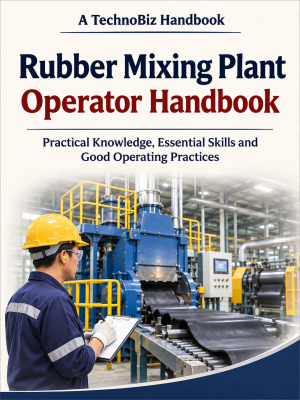
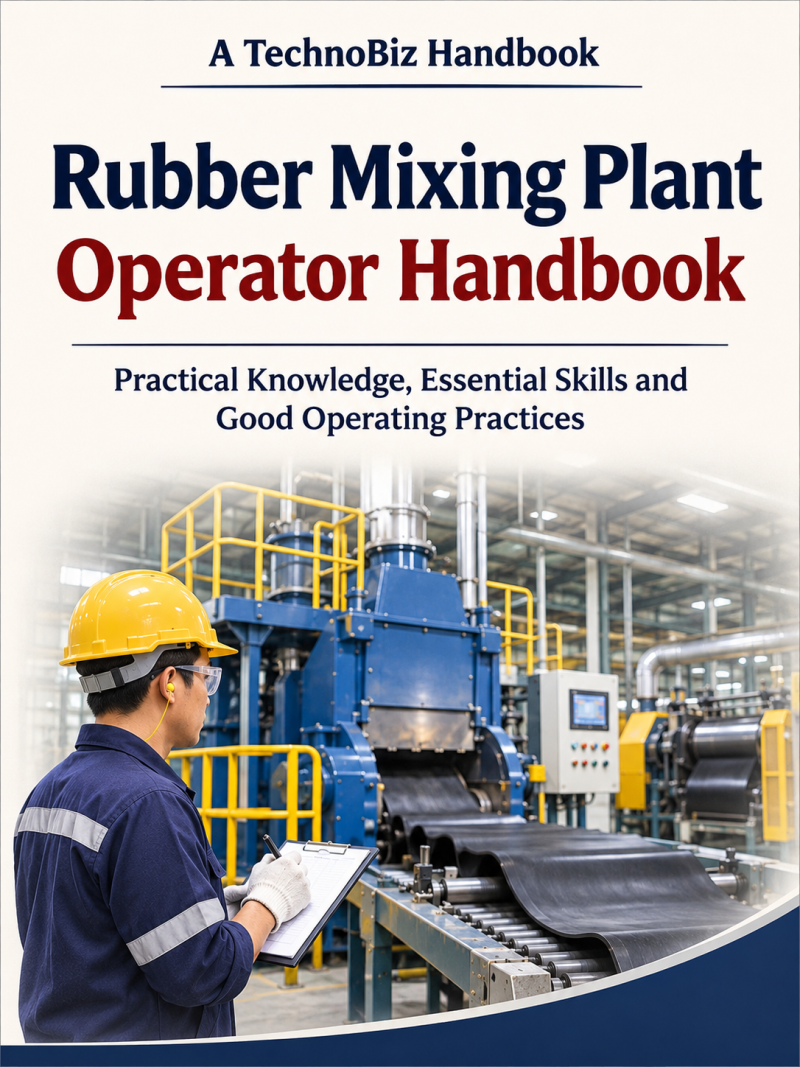
Rubber Mixing Plant Operator Handbook
Practical Knowledge, Essential Skills and Good Operating Practices
A TechnoBiz Handbook
Format: PDF eBook
Number of Pages: 403
Edition: 2026
Language: English
Contents: 12 Parts and 60 Chapters
Book Overview
The Rubber Mixing Plant Operator Handbook is a comprehensive, practical and systematically structured training resource developed specifically for personnel working in rubber mixing plants. The handbook focuses on the essential knowledge, practical skills, safety awareness, quality consciousness and good operating practices required to perform daily responsibilities effectively.
Written in simple, easy-to-understand English and supported by extensive visual illustrations, the handbook explains the entire rubber mixing operation, from raw material identification, preparation, weighing and batching to mixing, milling, cooling, compound testing, storage and release. It is relevant to both tyre and non-tyre rubber manufacturing industries operating manual, semi-automatic, automated and open-mill mixing systems.
Purpose of the Handbook
The primary purpose of this handbook is to empower rubber mixing plant operators with practical knowledge and essential skills to perform their jobs safely, correctly, consistently and confidently.
Rather than focusing on complex rubber chemistry or engineering theory, the book helps operators understand what they should do, why each activity matters, what can go wrong, how to recognize abnormalities and when to stop and report problems.
It is also designed to help rubber manufacturing companies establish systematic operator training programmes, improve workforce competency, prevent human errors, reduce manufacturing losses and develop a strong culture of safety, quality and continuous improvement.
Book Contents
Part 1 – Operator Responsibilities and Safety Fundamentals
Operator roles, responsibilities, safety fundamentals, rubber compounds and mixing plant operations.
Part 2 – Raw Materials and Traceability
Natural and synthetic rubber, carbon black, silica, fillers, oils, rubber chemicals, material identification and storage.
Part 3 – Material Preparation, Weighing and Batching
Bale cutting, weighing fundamentals, small chemical preparation, batch kits, ingredient reconciliation and automatic dosing.
Part 4 – Understanding Mixing Plant Equipment
Internal mixers, mixer controls, two-roll mills, discharge equipment, batch-off systems and supporting utilities.
Part 5 – Understanding the Rubber Mixing Process
Mixing fundamentals, recipes, ingredient addition sequences, process parameters, fill factor, mixing stages, temperature control, mixing curves and compound maturation.
Part 6 – Good Operating Practices
Pre-shift checks, batch preparation, mixing cycle monitoring, start-up, shutdown, restart, compound changeover, rework and shift handover.
Part 7 – Compound Quality and Downstream Processing
Compound quality characteristics, laboratory testing, defect recognition, operator influence on quality and downstream manufacturing requirements.
Part 8 – Abnormality Recognition and Troubleshooting
Machine abnormalities, process deviations, operator decision-making, human error prevention and basic problem-solving.
Part 9 – Workplace Safety, Health and Environment
Machine hazards, chemical and dust safety, personal protective equipment, material handling, emergency response, housekeeping and environmental responsibility.
Part 10 – Productivity, Cost and Equipment Care
Manufacturing waste, productivity awareness, energy and resource efficiency, and operator-level equipment care.
Part 11 – Operator Discipline and Improvement
Teamwork, workplace communication, professional discipline, continuous improvement and digital working habits.
Part 12 – Systematic Training and Competency Development
Operator training pathways, workstation learning, practical competency assessment and maintaining competency.
Key Features
- 60 practical, operator-focused chapters.
- More than 130 informative visual illustrations.
- 300 knowledge assessment questions with answers.
- More than 90 workplace training scenarios.
- Chapter-wise learning objectives and practical demonstrations.
- Good operating practices and common mistakes.
- Safety-critical guidelines and stop-and-report conditions.
- Practical checklists and quick-reference sheets.
- Two sample final assessment papers.
- 28 adaptable training forms and templates.
- Operator competency assessment and workstation skill matrix.
- Defect recognition atlas and troubleshooting guide.
- Illustrated technical glossary.
- 20 golden rules for rubber mixing operators.
- Integrated case study covering the complete journey of a rubber compound batch.
Who Should Read This Handbook?
- Rubber mixing plant operators – new and experienced.
- Raw material preparation and weighing personnel.
- Internal mixer and two-roll mill operators.
- Batch-off and compound handling operators.
- Warehouse and material storage personnel.
- Production supervisors and shift leaders.
- Production and factory managers.
- Quality control and technical personnel.
- Maintenance and industrial safety personnel.
- Human resource and training managers.
- Industrial trainers and competency assessors.
- Engineering students and professionals entering the rubber industry.
A Practical Resource for Systematic Operator Training
This handbook goes beyond conventional technical reading material. It provides a structured framework that rubber manufacturing companies can use for employee induction, foundation training, comprehensive operator training, refresher programmes, supervised workstation learning and competency assessment.
Companies can adapt the training forms, checklists and assessment tools to their own operating environment and training requirements while following their approved operating and safety procedures.
Why Should Rubber Manufacturers Invest in This Handbook?
The quality of a rubber product begins in the mixing plant. Even a small operator error can lead to compound rejection, production losses, downstream processing difficulties or customer complaints.
Investing in operator knowledge and skills can help companies improve compound consistency, workplace safety, productivity, material utilization, equipment care and overall manufacturing performance.
TechnoBiz encourages rubber manufacturing companies to use this handbook as a systematic training resource to educate, upskill and empower their mixing plant teams.
Knowledgeable Operators. Safer Operations. Consistent Quality. Better Productivity.