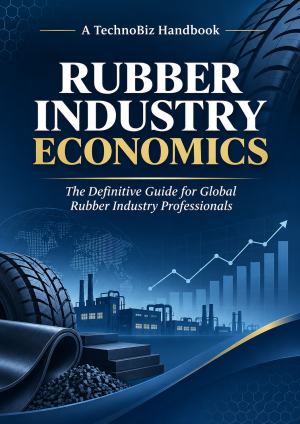
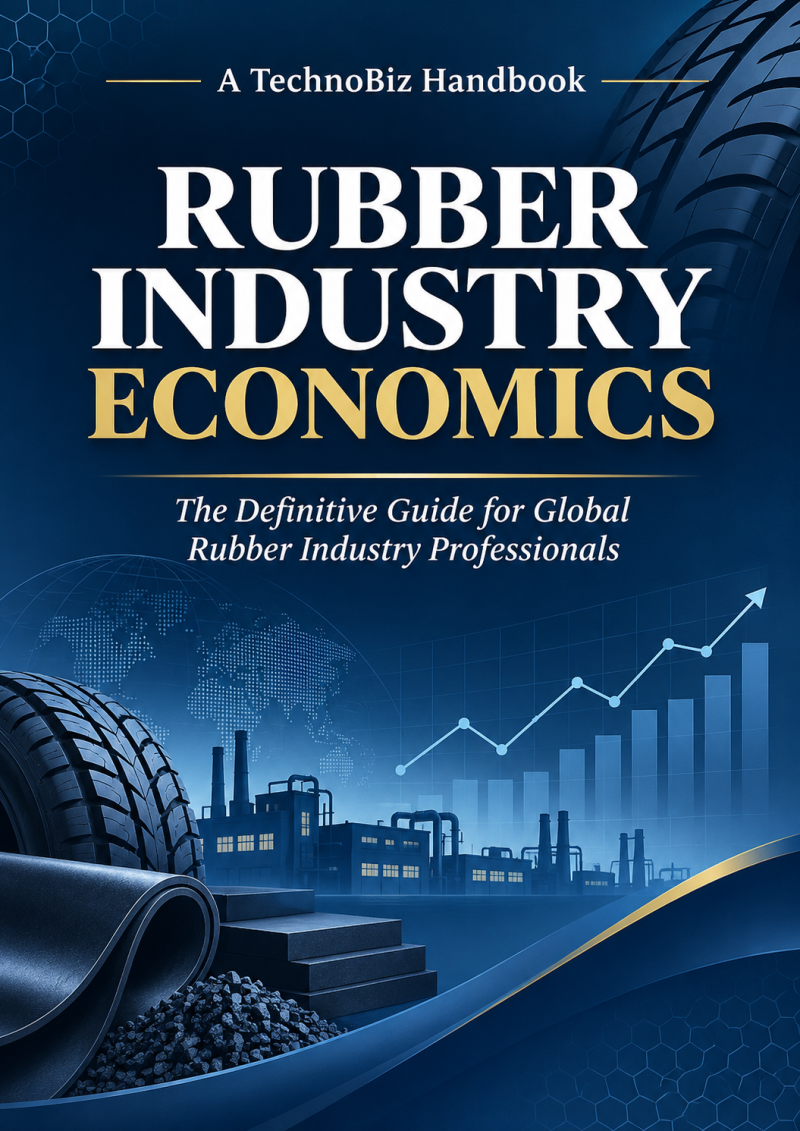
Rubber Industry Economics
The Definitive Guide for Global Rubber Industry Professionals
A TechnoBiz Handbook
Format: E-Book (PDF)
Number of Pages: 616
Edition: First Edition, 2026
Language: English
Publisher: TechnoBiz
About the Book
Rubber Industry Economics is a comprehensive and practical handbook designed to bridge the gap between rubber manufacturing technology and business economics. While technical expertise is essential for producing high-quality rubber products, understanding the economic consequences of technical, operational, commercial and strategic decisions is equally important for achieving sustainable profitability and business growth.
Organised into six parts and 34 chapters, this handbook covers the entire spectrum of rubber manufacturing economics, from the cost of a kilogram of rubber compound to the valuation of an entire rubber manufacturing business. It provides economic frameworks, illustrative worked examples, calculation methods, comparative tables, case studies and practical management insights to help readers understand where money is earned, spent, lost and invested in rubber manufacturing operations.
The handbook addresses both day-to-day factory challenges and long-term strategic issues, including raw material price volatility, production efficiency, hidden losses, energy consumption, customer profitability, working capital, machinery investment, sustainability, regulatory compliance, electric vehicle transition and digital transformation.
Purpose of the Book
The primary purpose of this handbook is to strengthen economic thinking among rubber industry professionals and enable better-informed business decisions. It aims to help readers:
- Understand the true cost of rubber compounds and finished rubber products.
- Connect technical and operational decisions with financial outcomes.
- Identify hidden losses and opportunities for profitability improvement.
- Improve material, machinery, labour and energy efficiency.
- Develop effective pricing, procurement and customer management strategies.
- Evaluate capital investments, automation and factory expansion.
- Improve working capital management and financial discipline.
- Understand the economics of sustainability, innovation and regulatory compliance.
- Build competitive, resilient and financially sustainable rubber manufacturing businesses.
The central philosophy of this handbook is that technical excellence must be supported by economic understanding to achieve sustainable business success.
Book Contents
Part One – Foundations of Rubber Industry Economics
- Introduction to Rubber Industry Economics
- Understanding Manufacturing Costs
- Raw Material & Compound Economics
- Rubber Mixing Economics
- Processing & Production Economics
Part Two – Factory Productivity & Cost Optimisation
- Machine Utilisation & OEE
- Labour, Workforce & Culture Economics
- Scrap, Waste & Rework Economics
- Energy & Utility Economics
- Maintenance & Reliability Economics
- Quality Economics & Risk Management
Part Three – Supply Chain, Procurement & Commercial Economics
- Supply Chain & Procurement Economics
- Commodity Price Risk & NR/SR Market Economics
- Inventory & Warehouse Economics
- Rubber Product Pricing & Profitability
- Customer Segment Economics
- Investment & Factory Expansion Economics
- Tolling, Subcontracting & Joint Venture Economics
Part Four – Strategic & Future Economics
- Sustainability, Circular Economy & ESG Economics
- New Product Development & Customer Specification Economics
- Innovation, R&D & Technology Economics
- Global Rubber Market & ASEAN Economics
- EV Transition: Threat, Opportunity & Strategic Response
Part Five – Practical Factory Economics
- Economics for SMEs & Rubber Entrepreneurs
- Hidden Losses in Rubber Factories
- Economics of Technical Decisions
- Factory Financial Management Economics
- Factory KPI Systems & Economic Analysis
- Case Studies in Rubber Industry Economics
Part Six – Advanced & Specialist Economics
- Regulations, Compliance & Legal Economics
- Sector-Specific Economics: Tyre, Medical, Aerospace & Oil and Gas
- Mergers, Acquisitions & Exit Economics
- Digital Transformation & Industry 4.0 Economics
- Building a Learning Organisation: Continuous Improvement Economics
Appendices
- Appendix A: Rubber Industry Economic Terms – Glossary A to Z
- Appendix B: Key Economic Formulas
- Appendix C: Sources and Further Reading
Key Features of the Handbook
- 616 pages of comprehensive industry-focused content.
- 34 chapters organised into six thematic parts.
- 63 worked examples and 142 numbered data tables, as stated in the handbook’s executive summary.
- 11 integrated case studies.
- Five factory failure analyses with early warning signs and management lessons.
- Ten fundamental principles of rubber industry economics.
- Guided reading pathways for different professional roles and business situations.
- Rubber Factory Profitability Model.
- Hidden Loss Pyramid framework.
- Technical Decision Scorecard.
- Factory economic performance dashboards and KPI frameworks.
- Practical financial and economic calculation methods.
- USD-denominated illustrative examples that readers can adapt to their own factory conditions.
- Global industry perspective with particular reference to ASEAN rubber manufacturing.
Who Should Read This Book?
Rubber Industry CEOs, Managing Directors and Business Owners: To gain a comprehensive understanding of factory economics, profitability, investment decisions, business risks and sustainable growth strategies.
Factory, Operations and Production Managers: To understand the financial impact of production efficiency, machine utilisation, cycle time, material consumption, downtime and operational losses.
Rubber Technologists, Compounders and R&D Professionals: To evaluate the economics of compound formulations, material substitution, processing technologies, product development and technical innovation.
Finance and Accounting Professionals: To better understand rubber manufacturing operations, product costing, contribution margins, working capital requirements and investment evaluation.
Purchasing and Supply Chain Managers: To develop effective procurement strategies, manage commodity price risks, optimise inventory and evaluate supplier economics.
Marketing, Sales and Business Development Professionals: To improve product pricing, customer profitability, market segmentation, quotation strategies and commercial decision-making.
Quality, Maintenance and Utility Managers: To quantify the economic consequences of quality failures, equipment breakdowns, energy losses and improvement initiatives.
Rubber Industry Entrepreneurs and SMEs: To understand startup economics, minimum viable operations, financing, business expansion and financial risk management.
Rubber Industry Consultants and Trainers: To access structured economic frameworks, illustrative calculations and case studies for professional consulting and industry training.
Academicians, Researchers and Students: To complement technical education with practical knowledge of manufacturing economics and industrial business management.
Why Should You Read This Book?
- To understand the financial consequences of everyday technical and operational decisions.
- To discover where profitability is lost within rubber manufacturing operations.
- To move beyond conventional cost-cutting towards sustainable economic optimisation.
- To distinguish genuine financial savings from theoretical improvement opportunities.
- To evaluate machinery, automation and technology investments more systematically.
- To improve collaboration between technical, production, commercial and finance departments.
- To understand changing market trends, sustainability requirements and emerging business opportunities.
- To develop a stronger economic mindset alongside technical expertise.
- To make better-informed decisions based on data, calculations and economic reasoning.
- To build a more profitable, competitive and resilient rubber manufacturing business.
What Makes This Handbook Different?
Unlike conventional rubber technology textbooks or general business management books, Rubber Industry Economics specifically connects the technical realities of rubber manufacturing with practical financial and economic principles.
It explains not only how manufacturing improvements can be achieved, but also how their economic value can be calculated, evaluated and verified. The illustrative examples and management frameworks are designed to help professionals adapt the concepts to their own products, processes, factories and business conditions.
This handbook serves as both a structured learning resource and a practical reference for professionals across the rubber manufacturing value chain.
A valuable reference for every rubber industry professional who wants to think beyond technology, understand the economics of manufacturing and contribute to sustainable business profitability.
Technical Excellence. Economic Understanding. Sustainable Profitability.