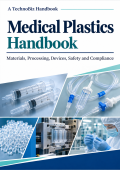
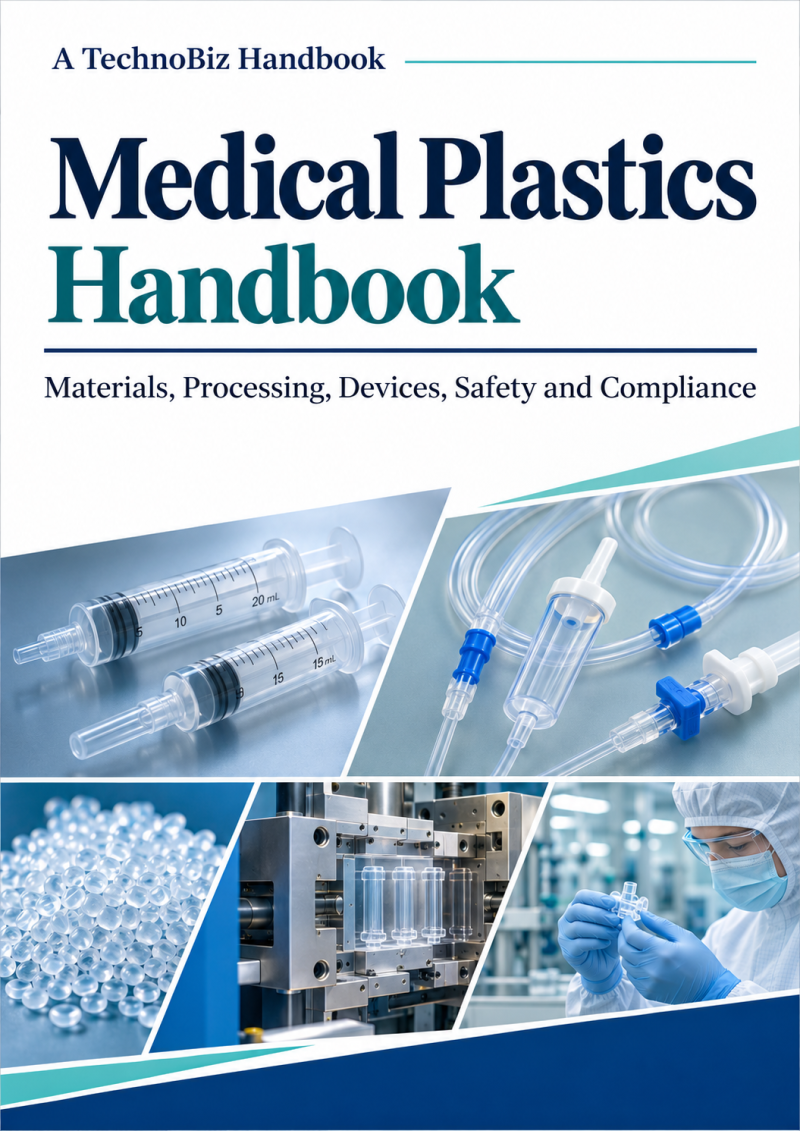
Medical Plastics Handbook
Materials, Processing, Devices, Safety and Compliance
A TechnoBiz Handbook | First Edition – November 2026
Format: Digital Book (PDF)
Length: 457 Pages
Publisher: TechnoBiz
About the Handbook: Medical plastics play a critical role in modern healthcare, from disposable syringes, intravenous tubing and diagnostic cartridges to advanced catheters, drug-delivery systems, surgical instruments and implantable medical devices. Selecting the right polymer is only the beginning. Successful medical plastic products require careful consideration of material properties, manufacturing processes, device performance, biological safety, sterilization compatibility, quality assurance and regulatory compliance.
The Medical Plastics Handbook is a comprehensive technical and practical reference designed to bring these essential subjects together in a single publication.
Covering the complete journey from polymer selection and material qualification to component design, manufacturing, device applications, testing, validation and regulatory documentation, the handbook provides a systematic understanding of the medical plastics industry.
It explains the characteristics and limitations of commonly used medical polymers, including polypropylene, polyethylene, PVC, polycarbonate, ABS, engineering thermoplastics, high-performance polymers, thermoplastic elastomers, silicone rubber, polyurethanes, bioresorbable materials and implant-relevant polymers.
Special attention is given to practical manufacturing technologies such as injection molding, extrusion, blow molding, thermoforming, joining, microfabrication and additive manufacturing.
The handbook also examines critical challenges including contamination control, environmental stress cracking, material degradation, extractables and leachables, drug–polymer interactions, sterilization damage, dimensional variation, device failure and supply-chain changes.
Beyond polymer technology, the book addresses biological evaluation, ISO 10993, ISO 13485, ISO 14971, FDA QMSR, EU MDR/IVDR, process validation, technical documentation, sustainability and emerging technologies.
The central message of this handbook is that medical suitability cannot be established by polymer designation alone. It must be demonstrated through material-specific, process-specific and finished-device evidence appropriate to the intended application.
Book Contents
The handbook is systematically organized into 6 Parts, 24 Chapters and 10 Appendices.
PART I – FOUNDATIONS
Chapter 1. Medical Plastics: Scope, History and Industry Ecosystem
Introduces medical plastics, their evolution, applications, industry value chain, supplier responsibilities, patient-contact classifications and the boundaries between medical devices, diagnostics, pharmaceutical packaging and general laboratory products.
Chapter 2. Fundamentals of Polymers for Medical Applications
Explains polymer structures, molecular properties, crystallinity, viscoelasticity, rheology, mechanical and thermal behavior, additives, aging, chemical resistance, environmental stress cracking and plastic–fluid interactions.
Chapter 3. Medical Device Development and Material Qualification
Covers intended use, design inputs, material qualification, risk management, design controls, verification, validation, supplier qualification, prototype development, production scale-up, change control and technical traceability.
PART II – POLYMERS AND SELECTION
Chapter 4. Commodity and High-Volume Medical Polymers
Discusses polypropylene, polyethylene, UHMWPE, medical PVC, polystyrene, PET, PETG and copolyesters, including properties, formulations, processing, sterilization compatibility, applications and material limitations.
Chapter 5. Engineering and High-Performance Polymers
Examines polycarbonate, ABS, SAN, polyamides, acetal, PBT, PEEK, PEI, PPSU, PSU, PESU and fluoropolymers, with emphasis on performance, processing, chemical compatibility, stress cracking and repeated sterilization.
Chapter 6. Elastomers, Soft Polymers and Specialty Materials
Covers thermoplastic elastomers, TPU, silicone elastomers, flexible compounds, compression set, bonding, overmolding, migration, surface modification, skin adhesives and wearable-device materials.
Chapter 7. Biomaterials, Bioresorbables and Implant-Relevant Polymers
Explains bio-based, biodegradable and bioresorbable polymers, including PLA, PGA, PLGA, PCL, UHMWPE and PEEK, together with degradation, wear debris, biological response, implant performance and long-term material stability.
Chapter 8. Material Selection, Additives and Supply Chain Control
Provides methods for selecting medical polymer grades, assessing additives and masterbatches, establishing material specifications, qualifying suppliers, reviewing certificates of analysis, managing formulation changes and maintaining supply continuity.
PART III – DESIGN AND PROCESSING
Chapter 9. Design for Manufacturability of Medical Plastic Parts
Explains wall thickness, ribs, bosses, snap-fits, seals, connectors, tolerance analysis, mold-flow considerations, stress concentration, fluid-path design, cleanliness and design verification.
Chapter 10. Injection Molding for Medical Plastics
Covers molding machines and tooling, resin preparation, drying, filling, packing, cooling, process windows, scientific molding, dimensional control, clean manufacturing, common defects, IQ/OQ/PQ and production validation.
Chapter 11. Extrusion, Tubing and Film Processing
Addresses medical tubing and film extrusion, die design, coextrusion, multilayer tubing, lumen control, dimensional inspection, reinforcement, balloon tubing, particulate control and extrusion troubleshooting.
Chapter 12. Blow Molding, Thermoforming and Other Conversion
Discusses extrusion blow molding, injection blow molding, stretch blow molding, thermoforming, compression molding, rotational molding, tooling, packaging components and process selection.
Chapter 13. Joining, Assembly, Microfabrication and Additive Manufacturing
Covers ultrasonic and laser welding, thermal and solvent bonding, adhesives, mechanical assembly, overmolding, micro-molding, additive manufacturing, surface treatment, bond integrity and process qualification.
PART IV – DEVICE APPLICATIONS
Chapter 14. Disposable Medical Devices and Fluid Management
Examines syringes, IV sets, connectors, valves, catheters, respiratory disposables, laboratory consumables, fluid-contact materials, leak testing, particulates, occlusion and common device failures.
Chapter 15. Drug Delivery, Pharmaceutical Packaging and Combination Products
Discusses vials, cartridges, closures, prefilled syringes, infusion and inhalation systems, drug–polymer compatibility, sorption, extractables and leachables, barrier properties, container-closure integrity and combination-product requirements.
Chapter 16. Diagnostics, Laboratory and Point-of-Care Devices
Explores in vitro diagnostics, microfluidic cartridges, diagnostic cassettes, optical properties, assay interference, reagent storage, laboratory plastics, specimen-contact considerations and precision manufacturing.
Chapter 17. Surgical, Reusable, Implantable and Emerging Devices
Covers surgical instruments, reusable equipment, sterilizable polymers, orthopedic and dental applications, implants, fatigue, wear, patient-contact electronics, wearable devices and patient-specific additive manufacturing.
PART V – SAFETY, STERILIZATION AND QUALITY
Chapter 18. Biological Evaluation and Chemical Safety
Explains biological evaluation under the ISO 10993 framework, patient-contact assessment, chemical characterization, extractables and leachables, toxicological risk assessment, biological endpoints and finished-device safety evaluation.
Chapter 19. Sterilization, Disinfection and Packaging Compatibility
Covers ethylene oxide, radiation, steam and other sterilization methods, polymer compatibility, material aging, sterile barrier systems, seal integrity, packaging validation, distribution testing and shelf-life determination.
Chapter 20. Testing, Metrology and Failure Analysis
Introduces mechanical, thermal, chemical, optical, dimensional and functional testing, leakage assessment, particulate analysis, measurement uncertainty, accelerated aging, fracture analysis and systematic failure investigation.
Chapter 21. Quality Systems, Controlled Manufacturing and Validation
Discusses ISO 13485, FDA QMSR, cleanroom controls, supplier quality, process validation, IQ/OQ/PQ, data integrity, material traceability, change management, corrective and preventive actions (CAPA) and post-market monitoring.
PART VI – COMPLIANCE AND INDUSTRIAL PRACTICE
Chapter 22. Regulatory Frameworks, Standards and Technical Documentation
Provides an overview of US FDA regulations, EU MDR and IVDR, medical-device classification, applicable ISO standards, regulatory requirements, technical documentation, labeling, market-access pathways and regulatory evidence management.
Chapter 23. Industrial Troubleshooting, Cost and Sustainability
Addresses manufacturing defects, failure analysis, process economics, scrap reduction, productivity, cost of quality, supplier continuity, recycling limitations, medical plastic waste management, lifecycle assessment and sustainability.
Chapter 24. Future Directions and Practical Implementation Roadmap
Explores precision manufacturing, miniaturization, connected devices, advanced surface technologies, artificial intelligence, digital traceability, sustainable materials and practical implementation strategies for manufacturers entering or expanding in the medical plastics industry.
Additional Reference Materials – 10 Appendices
The handbook includes practical technical references and working tools:
- Appendix A: Glossary and Acronyms
- Appendix B: Polymer Family and Abbreviation Index
- Appendix C: Properties and Testing Quick Reference
- Appendix D: Medical-Device Application / Material Cross-Reference
- Appendix E: Troubleshooting Quick Charts
- Appendix F: Supplier Qualification and Material Change Worksheets
- Appendix G: Manufacturing, Cleanliness and Process-Validation Checklists
- Appendix H: Standards and Regulations Applicability Register
- Appendix I: Figure Credits and Image Rights
- Appendix J: Case-Study and Calculation Templates
Special Features of This Handbook
Comprehensive Technical Coverage
Brings polymer science, material selection, manufacturing technology, device applications, quality systems and regulatory requirements into one integrated reference.
Practical Engineering Approach
Explains not only the technical principles but also their practical implications for manufacturing, processing, product design, troubleshooting and qualification.
Technical Illustrations and Diagrams
Includes original engineering illustrations, process schematics, material comparisons, decision trees, technical charts and visual explanations.
47 Illustrative Case Studies
Provides practical examples demonstrating material failures, manufacturing challenges, design issues, investigation methods and improvement strategies.
Troubleshooting and Decision-Making Tools
Includes 39 troubleshooting quick charts, along with reference tables, worksheets, checklists and decision aids for manufacturing and quality applications.
Regulatory and Safety Perspectives
Connects material and processing decisions with biological safety, risk management, sterilization, validation, documentation and applicable regulatory frameworks.
Industry-Oriented Implementation Guidance
Supports practical planning for manufacturers, converters and material suppliers interested in developing medical plastics manufacturing capabilities.
Who Should Read This Handbook?
This handbook is suitable for:
- Polymer and Materials Professionals: Polymer scientists, material development specialists, compounders and resin suppliers.
- Medical Device Manufacturers: Product developers, design engineers, technical managers and manufacturing professionals.
- Plastics Processors: Injection molders, extruders, thermoformers, toolmakers and precision-component manufacturers.
- Quality and Regulatory Professionals: Quality assurance engineers, quality-control managers, validation engineers, regulatory specialists and compliance personnel.
- Healthcare Product Suppliers: Manufacturers and suppliers of medical tubing, pharmaceutical packaging, diagnostics, disposable devices and implant-related components.
- Business Owners and Industry Managers: Companies exploring opportunities in medical plastics manufacturing and supply.
- Researchers, Academics and Students: Professionals and learners in polymer engineering, biomedical engineering, materials science and medical-device technology.
Why This Handbook Is Valuable
The medical plastics sector demands much more than conventional plastic processing knowledge. It requires an understanding of how polymer chemistry, material formulation, processing conditions, device design, sterilization, biological safety and regulatory expectations interact.
This handbook helps readers develop that integrated understanding, recognize potential material and manufacturing risks, make more informed technical decisions and build stronger quality and validation practices.
It can serve as a technical learning resource, manufacturing reference, internal training aid and practical guide for professionals working throughout the medical plastics value chain.