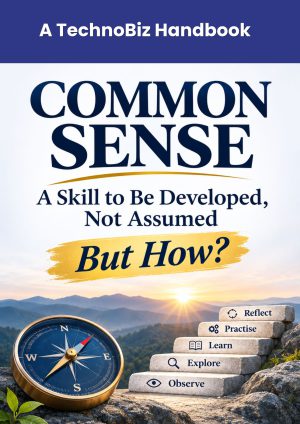
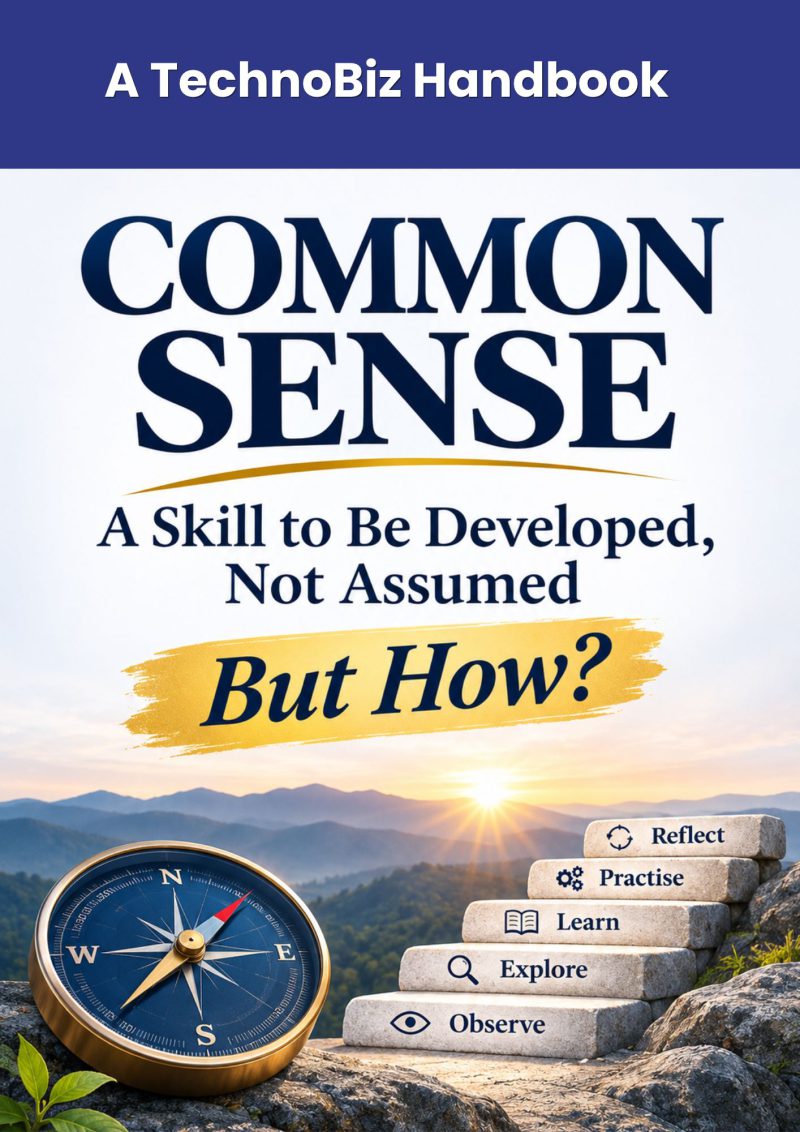
COMMON SENSE – A Skill to Be Developed, Not Assumed – But How?
A TechnoBiz Handbook
Book Summary
Common sense is often expected, rarely taught and frequently taken for granted. This thought-provoking handbook explores how common sense can be developed through experience, awareness, observation, reflection, practice and continuous learning. Through engaging stories, realistic workplace situations, insightful illustrations and practical exercises, the handbook explains why even highly educated and experienced individuals sometimes make poor decisions.
It provides practical guidance for developing sound judgment, improving decision-making and cultivating responsible professional behaviour. The handbook goes beyond explaining the importance of common sense by addressing the fundamental question: But how can we develop it in ourselves and others?
Book Format & Pages
- Format: E-Book (PDF)
- Total Pages: 215
- Publisher: TechnoBiz
Book Purpose
This handbook aims to establish common sense as an essential life and professional skill that can be consciously developed and strengthened. It helps readers improve their awareness, observation, critical thinking, problem-solving, communication, decision-making and sense of responsibility. It also provides practical guidance for managers, educators, mentors and parents to create environments that encourage the development of common sense in others.
Book Contents
The handbook comprises 24 chapters systematically organized into six major parts.
Part I – Understanding Common Sense
- Chapter 1 – What Is Common Sense?
- Chapter 2 – Born with Ability, Not Finished Judgment
- Chapter 3 – Knowledge, Intelligence and Practical Wisdom
- Chapter 4 – The Boundaries of Common Sense
Part II – Developing Awareness and Judgment
- Chapter 5 – Experience: Exposure Is Not Learning
- Chapter 6 – Awareness: Noticing the Context
- Chapter 7 – Observation and the Art of Asking
- Chapter 8 – Reflection and Feedback
Part III – Why Judgment Fails
- Chapter 9 – Assumptions, Habits and Blind Spots
- Chapter 10 – Bias and Overconfidence
- Chapter 11 – Emotion, Ego and Urgency
- Chapter 12 – Social Pressure and Silence
Part IV – Applying Common Sense at Work
- Chapter 13 – Communication with Purpose
- Chapter 14 – Problem-Solving Before Solution-Making
- Chapter 15 – Priorities, Time and Responsibility
- Chapter 16 – Safety, Quality and Ethical Judgment
Part V – Management, Business and Leadership
- Chapter 17 – Managing Resources and Avoiding Waste
- Chapter 18 – Customer and Commercial Judgment
- Chapter 19 – Leadership and Organizational Culture
- Chapter 20 – Judgment Under Uncertainty
Part VI – Instilling Common Sense in Others
- Chapter 21 – Teaching Common Sense to Graduates
- Chapter 22 – Mentoring and Developing Employees
- Chapter 23 – Common Sense in the Digital and AI Era
- Chapter 24 – Making Judgment a Lifelong Practice
Appendices – Practical Learning and Development Resources
- Appendix A – The Practical Judgment Checklist
- Appendix B – The SENSE Decision Worksheet
- Appendix C – A 30-Day Personal Development Programme
- Appendix D – A 90-Day Workplace Development Programme
- Appendix E – Decision Journal and Mentor Conversation Guide
- Appendix F – Development Conversation Rubric
- Appendix G – Scenario-Based Workshop
- Appendix H – A Team Learning Conversation
- Appendix I – Organizational Conditions for Sound Judgment
- Appendix J – Common Sense Myths and a Personal Reflection Profile
- Appendix K – Judgment Practice Cards
- Appendix L – Discussion Notes for Chapter Exercises
The handbook also includes a prologue, epilogue, final reflections, glossary, thematic subject guide, research references and further reading.
Special Features of This Handbook
- Storytelling-based learning through realistic professional and everyday situations.
- The SENSE Framework for practical decision-making.
- The Common Sense Development Cycle.
- The Common Sense Iceberg.
- The Knowing–Doing Gap.
- The Common Sense Bank.
- Insightful illustrations explaining practical judgment and its development.
- Dedicated “But How?” sections providing actionable guidance.
- 24 Decision Laboratories with thought-provoking scenarios.
- Research-based explanations and documented real-world cases.
- Practical exercises, observation diaries and reflection worksheets.
- Structured personal and workplace development programmes.
- Guidance for teaching, coaching and mentoring others.
Who Should Read This Book?
- Students and fresh graduates
- Working professionals and engineers
- Employees, team leaders and supervisors
- Managers and senior executives
- CEOs, entrepreneurs and business owners
- Human resources and employee development professionals
- Teachers, professors and educators
- Corporate trainers, coaches and mentors
- Parents interested in developing practical judgment in their children
- Anyone interested in personal development, professional effectiveness and responsible decision-making
Common sense is not something we should simply expect from others. It is a skill that we must continuously develop in ourselves and help nurture in others.