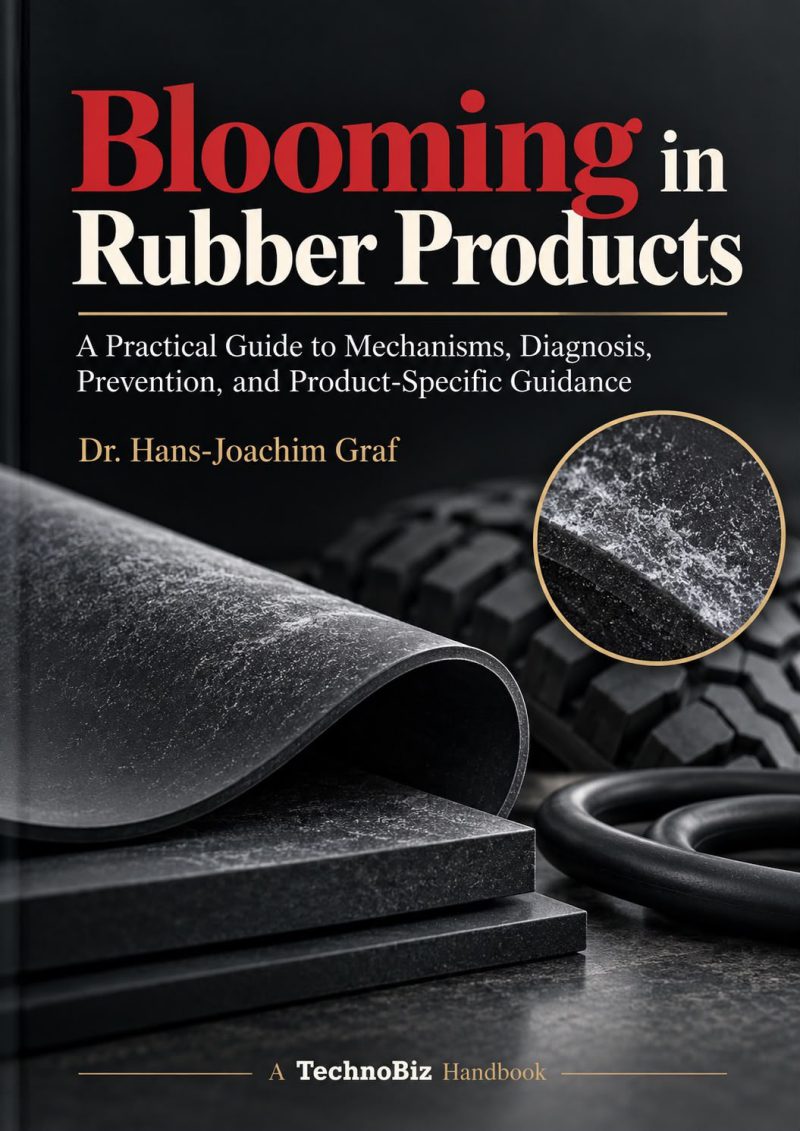
Blooming in Rubber Products
A Practical Guide to Mechanisms, Diagnosis, Prevention, and Product-Specific Guidance
Author: Dr. Hans-Joachim Graf
Publication: A TechnoBiz Handbook | 2026
Format: Digital Book (PDF)
Length: 270 Pages
About This Book
Blooming is one of the most common yet frequently misdiagnosed surface problems in rubber manufacturing. It can affect product appearance, adhesion, performance, quality, and customer satisfaction.
Blooming in Rubber Products is a comprehensive, practical handbook that explains the science behind blooming and provides systematic methods for identifying, investigating, preventing, and correcting bloom-related problems in natural and synthetic rubber products.
The book covers sulfur, accelerators, waxes, antidegradants, plasticizers, process oils, resins, and related surface phenomena. It explains the influence of formulation, polymer compatibility, mixing, vulcanization, temperature, storage, and environmental conditions on bloom formation.
Combining scientific principles with industrial troubleshooting practices, the handbook includes technical illustrations, diagnostic decision trees, laboratory identification methods, prevention strategies, case studies, and quick-reference guidance.
The central objective is to help rubber professionals move beyond treating visible surface defects toward identifying their root causes and implementing effective, long-term solutions.
Book Contents
Part I – Foundations of Blooming Phenomena
- Chapter 1: Introduction to Blooming in Rubber Products
- Chapter 2: The Science of Migration: Why Bloom Occurs
- Chapter 3: Classification of Bloom Types: A Practical Working Taxonomy
Part II – Practical Diagnosis and Identification
- Chapter 4: Visual Diagnosis: Distinguishing Bloom from Related Surface Defects
- Chapter 5: Field Diagnosis of Bloom
- Chapter 6: Laboratory Analytical Techniques for Bloom Characterization
- Chapter 7: Decision Tree for Bloom Investigation and Root Cause Analysis
Part III – Sulfur and Cure-System Bloom
- Chapter 8: Sulfur Bloom: Formation Mechanisms
- Chapter 9: Sulfur Bloom: Prevention and Remediation
- Chapter 10: Accelerator and Cure-Byproduct Bloom
Part IV – Wax Bloom
- Chapter 11: Wax Bloom: Controlled Migration or Surface Defect?
Part V – Antidegradant Bloom
- Chapter 12: Antidegradant Bloom
Part VI – Plasticizer, Metal Soap and Filler Bloom
- Chapter 13: Plasticizer, Process Oil and Resin Bloom
- Chapter 14: Filler- and Pigment-Related Surface Effects
Part VII – Bloom Behavior of Major Elastomer Families
- Chapter 15: Bloom Behavior in Natural Rubber (NR)
- Chapter 16: Bloom Behavior in Styrene-Butadiene Rubber (SBR) and Butadiene Rubber (BR)
- Chapter 17: Bloom Behavior in Butyl Rubber (IIR, CIIR and BIIR)
- Chapter 18: Bloom Behavior in Ethylene-Propylene-Diene Rubber (EPDM)
- Chapter 19: Bloom Behavior in NBR and HNBR
- Chapter 20: Bloom Behavior in Silicone (VMQ), Fluoroelastomer (FKM) and Polar Specialty Elastomers (ACM, AEM)
Part VIII – Process and Environmental Factors
- Chapter 21: Process and Environmental Factors Influencing Bloom
Part IX – Downstream Operations
- Chapter 22: Adhesion, Bonding, and Assembly Failures Related to Bloom
- Chapter 23: Printing, Coating, and Surface Finishing
Part X – Product-Specific Troubleshooting
- Chapter 24: Product-Specific Considerations
Part XI – Testing, Quality Control, and Training
- Chapter 25: Testing and Identification of Surface Deposits
- Chapter 26: Accelerated, Comparative and Long-Term Bloom Testing
- Chapter 27: Quality Control and Process Monitoring
- Chapter 28: Training, Documentation, and Knowledge Transfer
Part XII – Prevention Strategy and Program Design
- Chapter 29: Bloom Prevention Strategy and Program Design
Part XIII – Regulatory, Sustainability, and Emerging Technology
- Chapter 30: Regulatory, Sustainability and Emerging Technology Considerations
Part XIV – Economics and Customer Relations
- Chapter 31: Economics of Bloom and Customer Relations
Part XV – Case Studies and Quick Reference
- Chapter 32: Case Studies
- Chapter 33: Practical Bloom-Diagnosis Workflow
- Chapter 34: Quick Reference
- Chapter 35: Final Synthesis
Additional Resources
- Literature for Further Reading
- Appendix A: Bloom Species and Look-Alike Quick-Identification Reference
Who Should Read This Book?
This handbook is particularly valuable for rubber compound formulators, rubber technologists, production and process engineers, quality control and quality assurance professionals, laboratory analysts, technical managers, product development engineers, technical service personnel, and researchers working with natural and synthetic rubber.
It is also a useful training and troubleshooting reference for manufacturers of tires, hoses, seals, gaskets, footwear, automotive rubber components, industrial rubber goods, and other elastomer-based products.
What Makes This Book Valuable?
Rather than focusing only on the visible appearance of bloom, the handbook connects rubber chemistry, physical mechanisms, practical diagnosis, laboratory investigation, processing conditions, and corrective actions into a structured problem-solving approach.
Its case studies, illustrations, diagnostic workflows, and reference tables make it suitable for both technical learning and day-to-day industrial troubleshooting.
A practical reference for identifying the real causes of rubber blooming, preventing recurring surface defects, improving manufacturing consistency, and reducing quality-related costs.
Available through TechnoBiz Store: https://store.technobiz.org