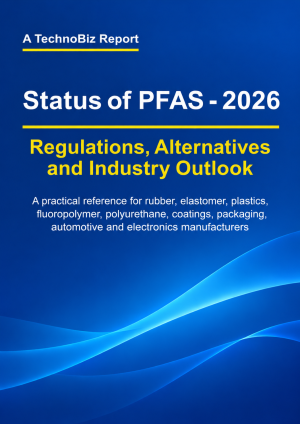
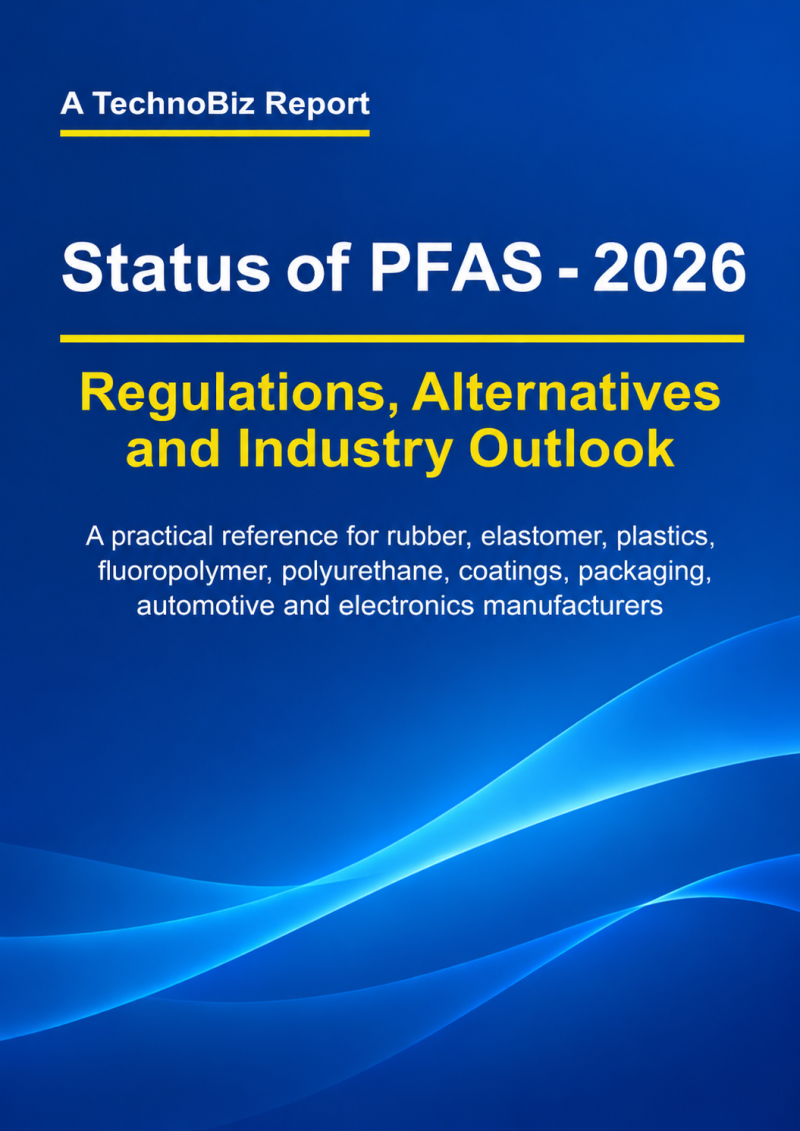
Status of PFAS – 2026: Regulations, Alternatives and Industry Outlook is a comprehensive 182-page TechnoBiz Report providing practical guidance on the evolving regulatory, technological, environmental and commercial landscape of per- and polyfluoroalkyl substances (PFAS), commonly known as forever chemicals.
PFAS are widely associated with high-performance industrial materials because of their chemical resistance, thermal stability, low friction and surface properties. However, increasing environmental and health concerns, regulatory restrictions and customer requirements are creating significant challenges for manufacturers and suppliers worldwide.
This report examines the current status of PFAS regulations, industrial applications, testing methods, alternative materials, substitution challenges and future developments. Particular attention is given to the rubber, elastomer, tyre, plastics, fluoropolymer, polyurethane, coatings, packaging, automotive, electronics and other manufacturing industries.
The publication explains where PFAS may occur in industrial materials and processes, which restrictions are already applicable, which regulations remain under consideration, and how companies can identify and qualify suitable alternatives.
It covers regulatory developments in the European Union, United States, United Kingdom, Canada, Thailand, ASEAN, India, China, Japan and South Korea, together with international controls under the Stockholm Convention. The regulatory information has a cut-off date of 10 November 2026.
Unlike general publications focused primarily on PFAS chemistry, toxicology or environmental remediation, this TechnoBiz Report emphasizes practical manufacturing decisions, technical substitution, regulatory compliance, supply-chain management and business implications.
List of Contents
Part I — PFAS Foundations
- PFAS Overview, Definitions and Terminology — PFAS classifications, chemical structures, regulatory definitions, industrial terminology and historical developments.
- Properties, Persistence, Exposure and Health Evidence — Performance characteristics, environmental persistence, exposure pathways, scientific evidence and industrial safety considerations.
- Global PFAS Value Chains and Use Mapping — Fluorochemical production, major manufacturers, feedstocks, processing aids, industrial supply chains and PFAS-use identification.
Part II — Industrial Applications
- Rubber, Fluoroelastomers and Sealing Systems — FKM, FFKM, FEPM, rubber processing, tyres, seals, gaskets, alternative elastomers and substitution qualification.
- Plastics and Fluoropolymers — PTFE, PVDF, FEP, PFA, ETFE, polymer processing aids, extrusion, coatings, recycled plastics and alternative materials.
- Polyurethane, Coatings, Adhesives and Textiles — Surface treatments, repellency, additives, coatings, adhesives, firefighting foams and fluorine-free technologies.
- Packaging, Food-Contact and Consumer Products — PFAS in food packaging, applicable restrictions, testing, barrier alternatives, recyclability and compliance documentation.
- Automotive, Electronics, Medical and Strategic Applications — Semiconductors, EV batteries, medical devices, aerospace, hydrogen technologies, refrigerants and critical industrial applications.
Part III — Regulations, Testing and Compliance
- European PFAS Regulatory Status — REACH, EU universal PFAS restriction proposal, POPs Regulation, PPWR, national measures, exemptions and compliance timelines.
- United States, Canada and the United Kingdom — Federal and state regulations, TSCA reporting, drinking-water rules, liability, product restrictions and business obligations.
- Asia and International Controls — Stockholm Convention, Thailand, ASEAN, India, China, Japan and South Korea, including implications for Asian exporters.
- Testing, Standards and Compliance Evidence — LC-MS/MS, total fluorine, organic fluorine, TOP assay, laboratory methods, sampling, detection limits and PFAS-free claims.
Part IV — Alternatives, Transition and Management
- PFAS-Free Alternatives by Industrial Function — Alternatives for sealing, coatings, repellency, lubrication, polymer processing and other industrial functions.
- Product Redesign and Qualification — Material selection, laboratory testing, pilot trials, accelerated ageing, customer approval and manufacturing change control.
- Manufacturing Emissions, Waste and Remediation — Emission prevention, wastewater treatment, recycling, PFAS capture, destruction technologies and waste management.
- Industry Case Studies and Corporate Responses — Industry initiatives, material substitution, manufacturing changes, corporate PFAS commitments and illustrative industrial cases.
Part V — Business Outlook and Industry Action
- Market, Costs and Commercial Opportunities — Supply-chain risks, compliance costs, material replacement economics, liability and emerging business opportunities.
- 2027–2035 Scenarios and Technology Outlook — Potential regulatory developments, emerging alternative technologies, research directions and future industry scenarios.
- PFAS Readiness Roadmap for Manufacturers — Practical 30-day, 90-day and 12-month action plans, supplier assessments, management dashboards and implementation tools.
Practical Appendices
- Appendix A: Regulatory Watchlist and Revision Record
- Appendix B: Industrial PFAS Use Inventory and Material Mapping
- Appendix C: Supplier Information Request Form and Declaration Wording
- Appendix D: Substitution and Qualification Worksheet
- Appendix E: Laboratory Test Request and Result Interpretation Checklist
- Appendix F: Bibliography
- Appendix G: Global PFAS Regulatory Dashboard
- Appendix H: PFAS Material-Use Identification Matrix
- Appendix I: Substitution Performance and Qualification Matrix
- Appendix J: PFAS-Free Statement Review and Laboratory Testing Checklist
- Appendix K: PFAS Readiness Scorecard and Use Risk Ranking
- Appendix L: Compliance-Cost Calculator and Assumptions Register
- Appendix M: Case-Study Evidence Records and Company-Claim Worksheet
- Appendix N: Country Profiles — Thailand and ASEAN, India, China, Japan and South Korea
- Appendix O: Claim-Level Source Audit Register
The report also includes a glossary, technical illustrations, regulatory comparisons, material-selection matrices and practical compliance tools.
Who Should Read This Report?
This publication is particularly useful for:
- Rubber, tyre and elastomer manufacturers
- Plastics processors and polymer compounders
- Fluoropolymer and chemical suppliers
- Polyurethane, coatings and adhesives manufacturers
- Packaging and food-contact material producers
- Automotive, electronics and medical device manufacturers
- R&D scientists, engineers and product designers
- Quality assurance and testing laboratory professionals
- Environmental, health and safety managers
- Regulatory compliance and sustainability professionals
- Procurement and supply-chain managers
- Business leaders, consultants, researchers and industry associations
Key Benefits
Readers will gain a clearer understanding of PFAS applications and regulatory developments, identify potential PFAS exposure within their materials and supply chains, evaluate available alternatives and their limitations, understand testing and documentation requirements, and develop practical strategies for managing PFAS-related technical, regulatory and commercial risks.
Status of PFAS – 2026 is designed to help industrial professionals make informed decisions as PFAS regulations, material technologies and market expectations continue to evolve.
Publication: A TechnoBiz Report
Title: Status of PFAS – 2026
Subtitle: Regulations, Alternatives and Industry Outlook
Format: Digital PDF
Length: 182 pages
Regulatory Cut-off: 10 November 2026
Publisher: TechnoBiz
Website: https://store.technobiz.org