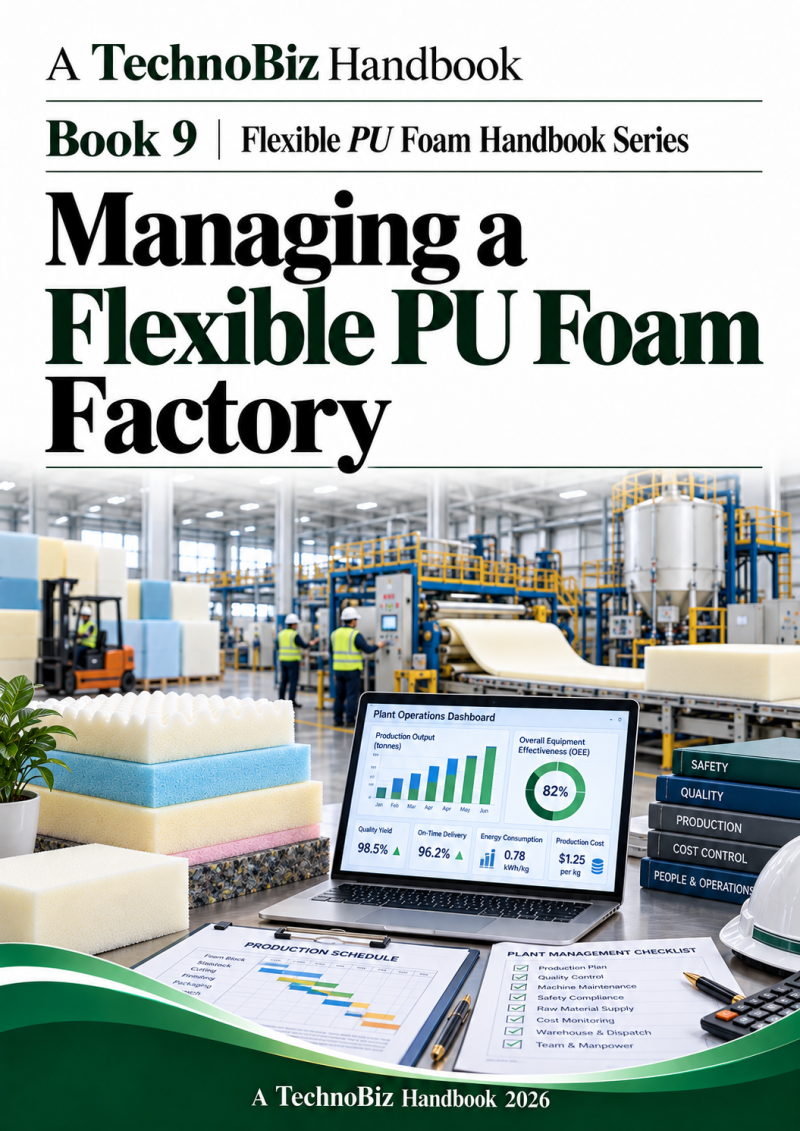
Managing a Flexible Polyurethane Foam Factory
Book 9 | TechnoBiz Flexible PU Foam Handbook Series | Format: PDF
Managing a Flexible Polyurethane Foam Factory is a practical, industry-focused handbook designed to help factory managers, production managers and supervisors improve the safety, productivity, quality, operational efficiency and profitability of flexible polyurethane foam manufacturing facilities. Covering 30 chapters across five major sections, the book provides a systematic approach to effective factory leadership, daily operations management, workforce coordination and continuous improvement.
The handbook explores shop-floor leadership, safe decision-making, safety culture, shift coordination, daily management meetings, production planning, inventory control, maintenance coordination, quality management and integrated management systems. It also explains how to develop and monitor key performance indicators (KPIs) covering safety, quality, delivery, productivity, material yield, overall equipment effectiveness (OEE), operating costs and workforce performance. Special attention is given to employee competence, effective communication, problem-solving, change management and leadership during emergencies.
With practical examples, illustrations, management frameworks, checklists, worked examples and ready-to-use templates, the book helps readers translate management principles into effective daily factory practices. It emphasises that successful factory management depends not only on equipment, formulations and technology, but also on disciplined systems, capable people, sound decisions and consistent leadership.
Who should read this book? This handbook is intended for flexible PU foam factory owners, CEOs, plant managers, production managers, shift leaders, supervisors, quality and maintenance managers, operations executives, consultants and professionals responsible for improving manufacturing performance.
The central objective of this handbook is to help flexible PU foam factories build safer workplaces, stronger management systems, competent teams and more efficient, reliable and profitable operations through practical leadership and continuous improvement.