

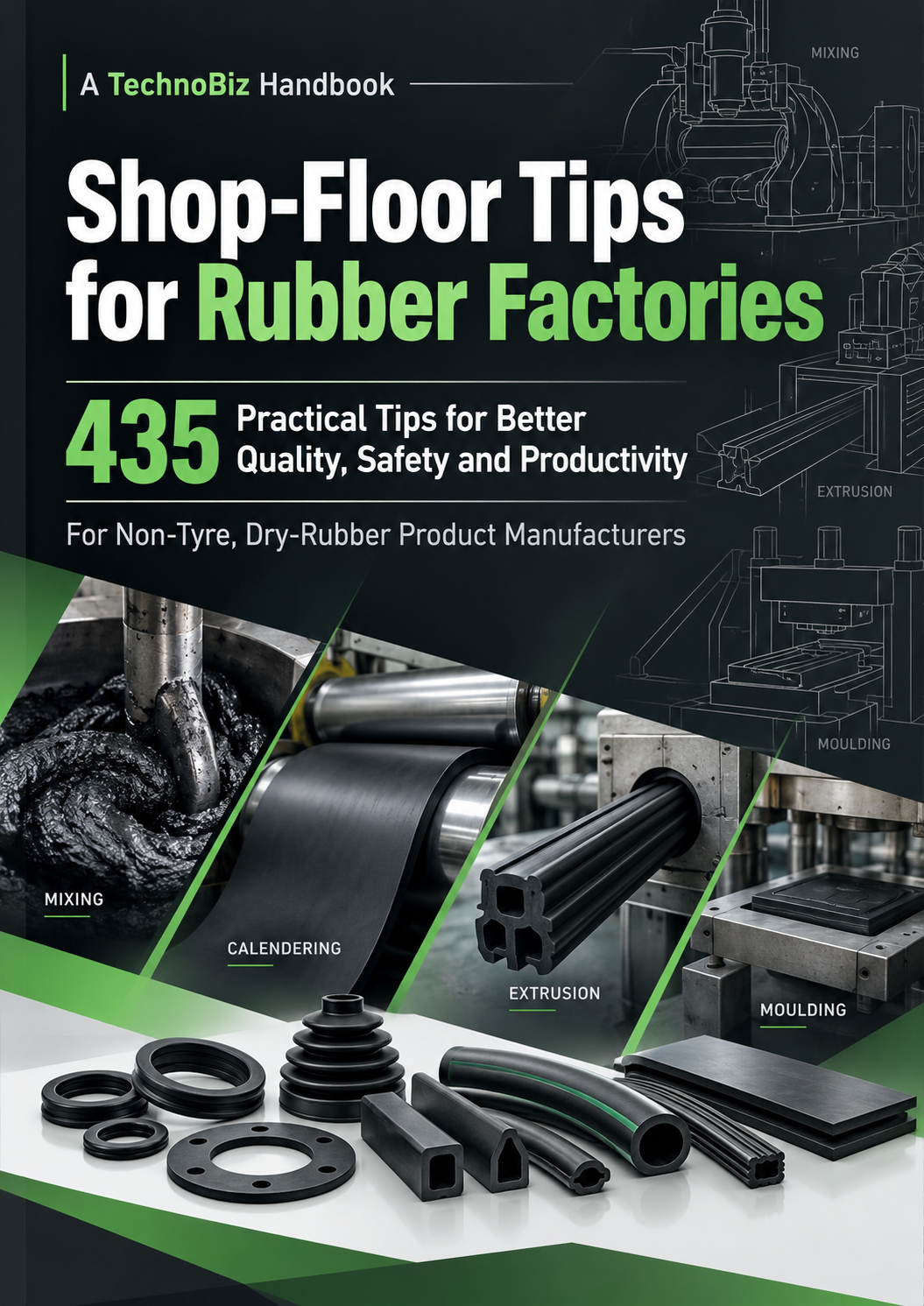
Shop-Floor Tips for Rubber Factories is a comprehensive practical handbook developed for non-tyre, dry-rubber product manufacturers. It presents 435 practical tips to help rubber factories improve product quality, workplace safety, production efficiency and cost control. Written in simple, easy-to-understand language, the book focuses on everyday manufacturing challenges, common mistakes, preventive measures and practical solutions. Each tip explains why it matters, what to check, what to do and what to avoid, supported by technical illustrations, flowcharts, tables and troubleshooting examples.
Book Contents
The handbook covers 20 chapters, including raw-material handling and storage, weighing and compounding, internal mixing, two-roll milling, compound storage, extrusion, calendering, moulding, tooling, rubber-to-metal bonding, vulcanisation, finishing, rubber testing, quality control, defect troubleshooting, machinery maintenance, workplace safety, production planning, waste reduction, energy efficiency and continuous improvement.
The book also includes nine practical appendices, featuring 50 common shop-floor mistakes, troubleshooting matrices, daily inspection checklists, record templates, technical terminology, 100 review questions, reference standards, 25 illustrative troubleshooting cases and product-specific manufacturing guidance.
Who Should Read This Book?
This handbook is recommended for rubber factory owners, production managers, plant managers, supervisors, shop-floor operators, technicians, quality control personnel, maintenance engineers, process engineers, trainers and rubber industry professionals.
It is particularly useful for manufacturers of rubber seals, gaskets, hoses, profiles, rollers, belts, diaphragms, antivibration components, rubber linings and other industrial rubber products.
Why Read This Book?
Rubber manufacturing performance often depends on small details that are easily overlooked. This handbook helps professionals recognise problems early, prevent repeat defects, strengthen shop-floor discipline, improve safety practices, reduce material waste and develop a culture of continuous improvement.
A practical reference for everyone involved in making rubber products better, safer and more efficiently.